Picture yourself stepping through the sliding glass doors into a neon-soaked paradise where the air smells like hairspray and pepperoni. The 1980s mall food court was not just a place to eat, it was the ultimate social lobby where you leveled up your coolness factor while dodging security. You would grab a tray, find a stiff plastic chair under a glowing skylight, and prepare for the peak sensory experience of the decade.
It was a glorious era of free samples on toothpicks and oversized pizza slices that were basically the size of a skateboard. Between the synthwave beats echoing from the record store and the glowing arcade cabinets nearby, you were living in a real-life movie montage. Whether you were there to flex your new denim jacket or just to loiter near the fountain, this high-calorie hub was the heart of the suburban universe.
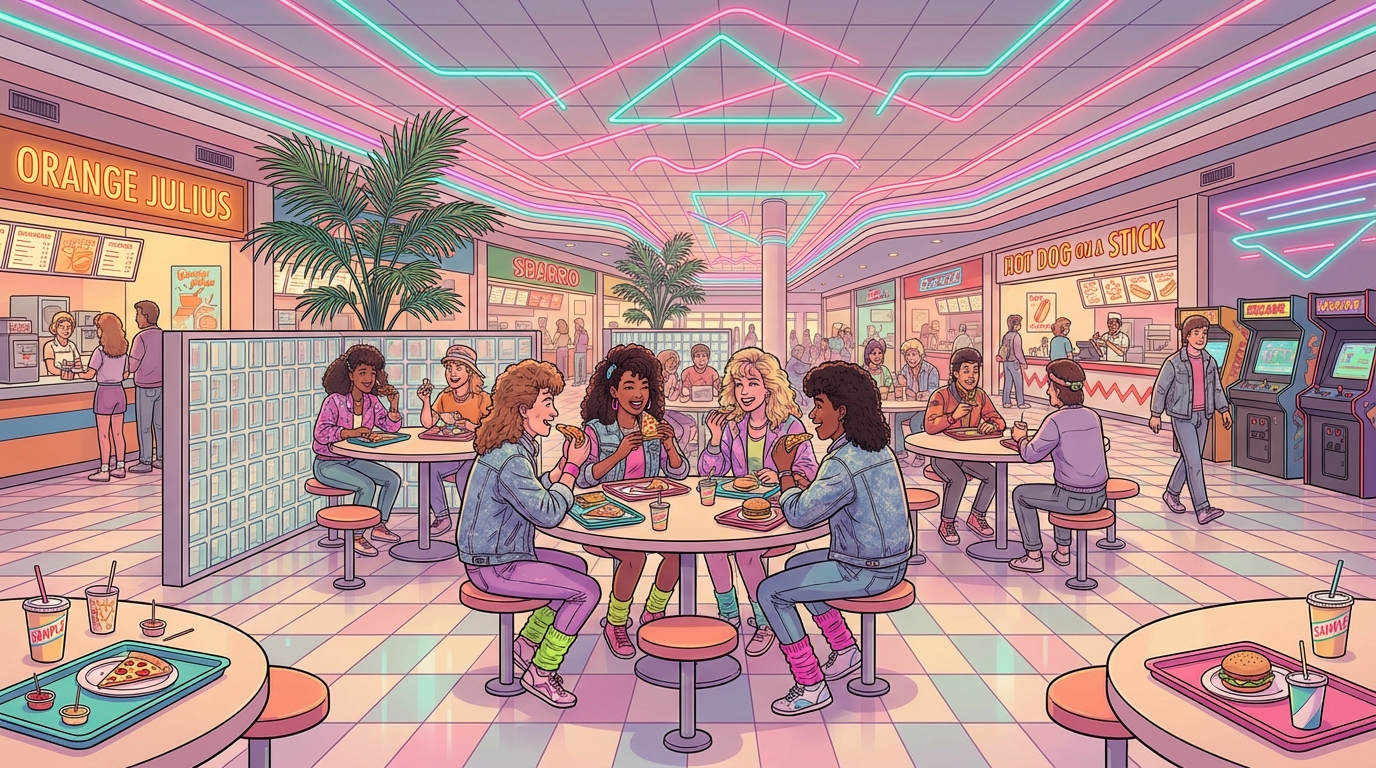
Walking into an 80s food court felt like stepping directly into a low-resolution rendering of a digital sunset. You were greeted by a sea of teal laminate tables and those iconic bolted-down swivel chairs that felt like they were designed for a space shuttle rather than a burger joint. Overlooking the scene were dusty plastic palm trees that never saw a drop of real rain, standing tall under a grid of humming neon tubes. The glowing pink and violet signage cast a hazy light over everything, making your tray of oversized pizza slices look like a prop from a synthwave music video. It was a masterpiece of artificial charm where every surface was polished to a high-gloss finish.
This was a high-sensory space where time seemed to stand still between the arcade and the record store. You navigated through a maze of geometric patterns and glass bricks while the smell of cinnamon rolls and bourbon chicken fought for dominance in the air. The architecture was loud and unapologetic, featuring vaulted skylights that made the neon glow even during the brightest parts of the afternoon. It felt like a social headquarters for everyone in acid-wash denim, providing the perfect backdrop for people-watching while you waited for your friends. Even the trash cans were color-coordinated to match the pastel aesthetic of the surrounding walls.
The true magic lived in the details, like the way the overhead fluorescent lights bounced off the brass railings and mirrored columns. You probably spent more time spinning in those stiff plastic seats than actually eating your food while the muffled sounds of pop hits echoed from a nearby department store. It was a bizarre mix of futuristic ambition and cozy community vibes that made every visit feel like an event. Today, these empty corridors might feel like a meme, but back then, they were the vibrant heart of the suburban universe. Each corner offered a new glow-in-the-dark photo op long before anyone knew what a selfie was.
Stepping into the neon glow of a 1980s food court was like entering a high-score screen where the prize was always deep-fried or covered in cheese. You would navigate through a sea of stiff plastic chairs and chrome accents, guided by the scent of buttery pretzels and heavy cologne. The air felt thick with the hum of a nearby arcade cabinet art and the collective chatter of every teenager in the zip code. It was a paradise of checkered floors and potted ferns where time seemed to stand still between shopping trips. You were not just there to eat a quick meal, because the food court was the undisputed social headquarters of the suburban universe.
Your journey usually began at the pizza counter, where a single slice of pepperoni was roughly the size of a skateboard. You would balance that greasy masterpiece while hunting for a frothy, citrus drink to wash down the salt with a cloud of mystery ingredients. No trip was truly complete without a tactical mission to the snack kiosks to snag a free sample of summer sausage on a toothpick. These small bites were the ultimate power-ups for your marathon through the department stores. Every sip and bite felt like a ritual performed under the soft hum of fluorescent lights and mall pop hits.
This holy trinity of flavors fueled your quest for the perfect cassette tape or a new pair of high-top sneakers. Sitting in those bolted-down seats felt like being at the center of the world while the rest of the mall blurred past in a vaporwave haze. You could spend hours watching the crowd flow by, fueled by sugar and processed meat while planning your next move. Even as the colors of the mall fade in your memory, the taste of that orange foam and salty snack remains locked in your brain. It was a glorious era of excess where the calories did not count as long as you had your friends by your side.
Long before you could scroll through a digital feed to see what your friends were up to, you had to physically station yourself at a laminate table with a view of the heavy foot traffic. The food court was the ultimate analog social network where your status was defined by your seat proximity to the fountain and the crispness of your new denim jacket. You spent hours nursing a single giant soda while scanning the crowd for your crush or the rival crew from the next town over. It was a high stakes game of seeing and being seen, illuminated by the hum of neon signs and the distant echoes of a synthpop hit playing over the mall speakers. This was your home base, a place where the air always smelled like a chaotic mix of buttery soft pretzels and heavy cologne.
Every corner of the seating area belonged to a different teen tribe, creating a colorful map of 80s subcultures right next to the pizza stand. You could track the latest trends in real time just by watching who was wearing the most neon lace or whose hair reached the highest altitudes with the help of extra strength spray. If you wanted to broadcast a message, you did not post a status update, you simply walked the perimeter of the food court with your boombox or your brightest accessories. These spaces functioned as a physical loading screen for your social life, providing a low resolution look at everyone’s weekend plans. It was the original social space where the plastic chairs were uncomfortable, but the vibes were absolutely legendary.
Take one last look at the flickering neon and those perfectly pastel tiles before we step back into the present day. The 1980s food court was more than just a place to grab a greasy slice of pizza or a toothpick loaded with bourbon chicken samples. It was a digital-hued sanctuary where the hum of the nearby arcade blended with the smell of cinnamon rolls and floor wax. You probably spent hours sitting in those stiff plastic chairs, watching the light bounce off chrome accents while planning your next move. Even though many of these physical spaces have faded into the foggy aesthetic of a vaporwave dream, their spirit is still very much alive.
Modern food halls are basically the high-definition remaster of the classic mall experience we all remember. Designers today are constantly chasing that specific emotional frequency, using retro-inspired lighting and open layouts to recreate the social magic of the era. You can see the influence of the food court in every trendy communal space that prioritizes vibes and variety over traditional sit-down service. It turns out that our collective craving for neon-soaked memories is just as strong as our old desire for an oversized soda. Our journey through the most delicious corner of history is wrapping up, but the nostalgia will always be ready for a replay.
Imagine a neon-soaked fever dream filled with teal laminate tables and bolted-down swivel chairs that felt like space shuttle seats. You were surrounded by dusty plastic palms and glowing pink signage that made everything look like a synthwave music video.
It was the ultimate social lobby where you could level up your coolness and flex your new denim jacket. The air was a mix of hairspray and pepperoni, creating a high-sensory experience that felt like living inside a real-life movie montage.
You could always find oversized pizza slices the size of a skateboard and free samples handed out on toothpicks. The smell of cinnamon rolls and bourbon chicken fought for dominance while you navigated the maze of glass bricks and geometric patterns.
Not at all, it was the heart of the suburban universe and a prime spot for loitering near the fountain. It served as a space between the arcade and the record store where you could dodge security and hang out with your crew.
The furniture was designed for maximum 80s aesthetic, featuring stiff plastic and high-gloss finishes. Those iconic swivel chairs were bolted to the floor to keep the geometric layout perfect under the humming neon tubes.
The combination of vaulted skylights and grid-like neon lighting created a low-resolution digital sunset vibe. It was a masterpiece of artificial charm where synthwave beats from the nearby record store provided the perfect soundtrack for your high-calorie lunch.