Cyberpunk megacorp tropes imagine giant companies as shadow governments, running the networks, the services, the security and even the neon-soaked streets you stroll down. Bruce Bethke almost certainly coined the term for a story published in November 1983, and it blew up after William Gibson’s 1984 novel Neuromancer, as The Science Fiction Encyclopedia notes.
Here’s the fun part: in real business, a megacorporation is not just any big brand. Scholars point to criteria like membership among a country’s 500 largest nonfinancial corporations, plus real market power, so your favorite sneaker company probably doesn’t qualify. The fictional version cranks the dial up to eleven, which is why the villain energy feels so believable. Pop culture ran with that gap between real and fiction, and the result is a genre that still feels current.
Cyberpunk megacorporations feel like governments because they do the jobs governments usually do, just with a logo on the door. The genre imagines companies running the networks you log into, the services you pay for, the security on your street and the buildings where you live. Nobody voted for them, and good luck filing a complaint with the company that owns your transit card.
The scale is what makes it sting. In these stories, industrial and political blocs are global rather than national, and they are controlled through information networks instead of borders and customs desks. Power moves through data, so no single country can simply push back.
Oxford Bibliographies’ 2024 cyberpunk overview identifies conflicts between governments and corporate society as a recurring worry in the genre. It also points to corporate control over less-privileged people, which comes at the cost of freedom and democracy.
Enter the rebels. Hackers, couriers and street-level outsiders are the characters who expose the costs: people pushed aside, personal data sold off and cheap labor keeping the neon lights on. They make the story hurt because they show you what that control feels like from the sidewalk.
The look took shape in the early 1980s, when writers started picturing computers running the global economy. Once the attitude caught on, the corporate skyline became a shorthand you can read in seconds, even if you’ve never cracked open a book from the genre.
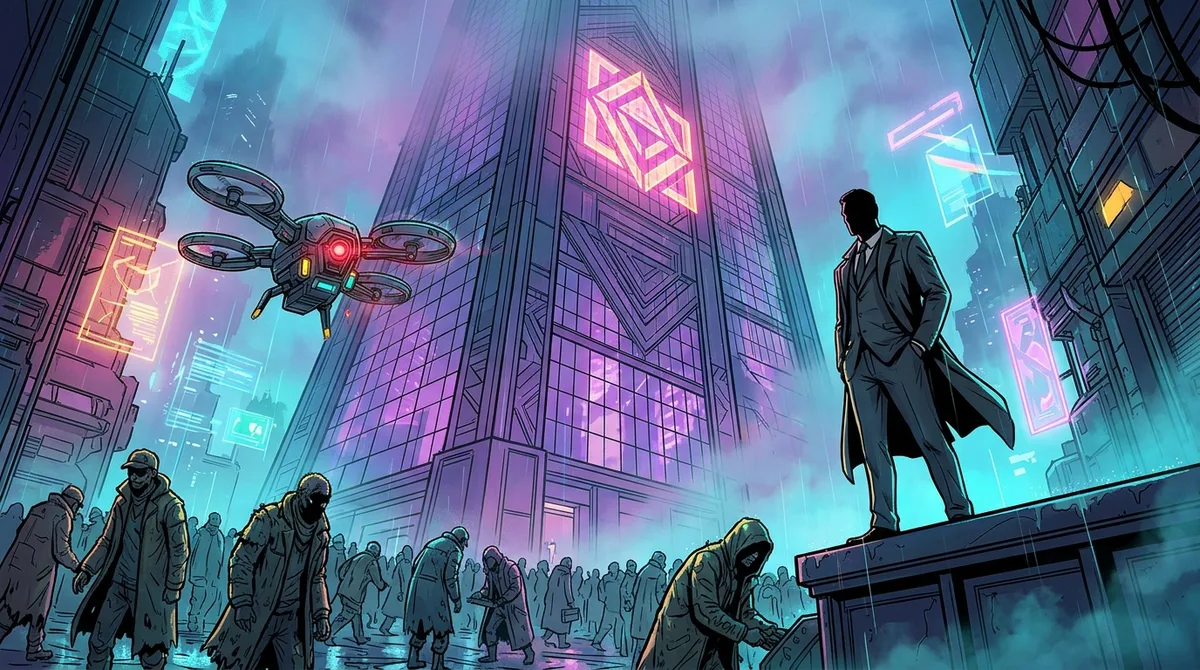
So the megacorp works as a villain that needs no backstory. One glance at a glass tower with a glowing logo tells you who is really in charge.
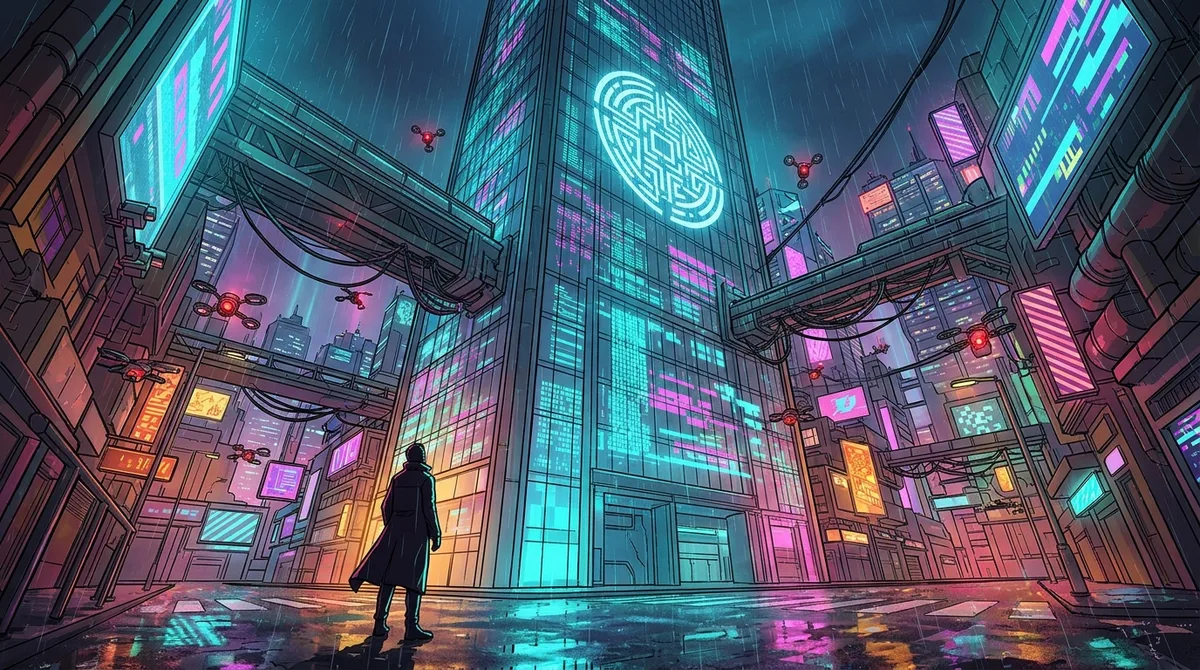
A megacorporation is a large company that holds real market power as a member of an oligopoly, a market where a handful of giant firms call most of the shots. Business scholarship uses the word for that situation, not for any company with a famous logo. A beloved brand with dozens of rivals fighting for the same shoppers is big, but it isn’t a megacorp.
Economist Alfred S. Eichner built a checklist for the term, and a 2022 article in Media, Culture & Society summarizes it. Under his criteria, a megacorporation:
Market power and oligopoly membership do the heavy lifting here. Size alone won’t get a company there. Separate management matters too, because it means the firm is run by professionals rather than one founder with a hunch.
Asia offers a handy real-world example. Super apps pack messaging, payments and shopping into a single app, and the giants behind them are closely tied to those services. WeChat belongs to Tencent, Jio is linked to Reliance, and LINE is tied to Naver and later SoftBank.
Once your chats, bills and takeout orders all live in one app, the company behind it starts to feel like a landlord you can’t move out on. That’s the cyberpunk pitch, just with better emojis. The fiction takes the same idea and skips the fine print about how much market power a company actually needs.
Corporate office towers look villainous because they were built to look powerful. Historic “corporate temple” headquarters were designed to project corporate power, and a Centre for London report notes that they were often heavily branded. Giant logos on the facade and lobby made sure nobody walking past could forget who was in charge.
The inside told the same story. Floors mirrored the workplace hierarchy, with ordinary staff near the bottom and senior executives higher up. Height was status, and the top floor was where the big decisions got made, far above the people who actually did the work.
Cyberpunk towers borrow directly from that tradition, which is why they feel so familiar. You recognize the glass walls, the glowing logo and the corner suite where the boss sits. The fiction then turns the dial up, giving you towers that cast shadows over whole districts and light up like neon billboards.
That mix of real architecture and exaggerated style is the secret. The building looks like a real office you could walk into on a Monday, but with a little more menace. Once you know the history, every glowing lobby starts to look a bit like a throne room.
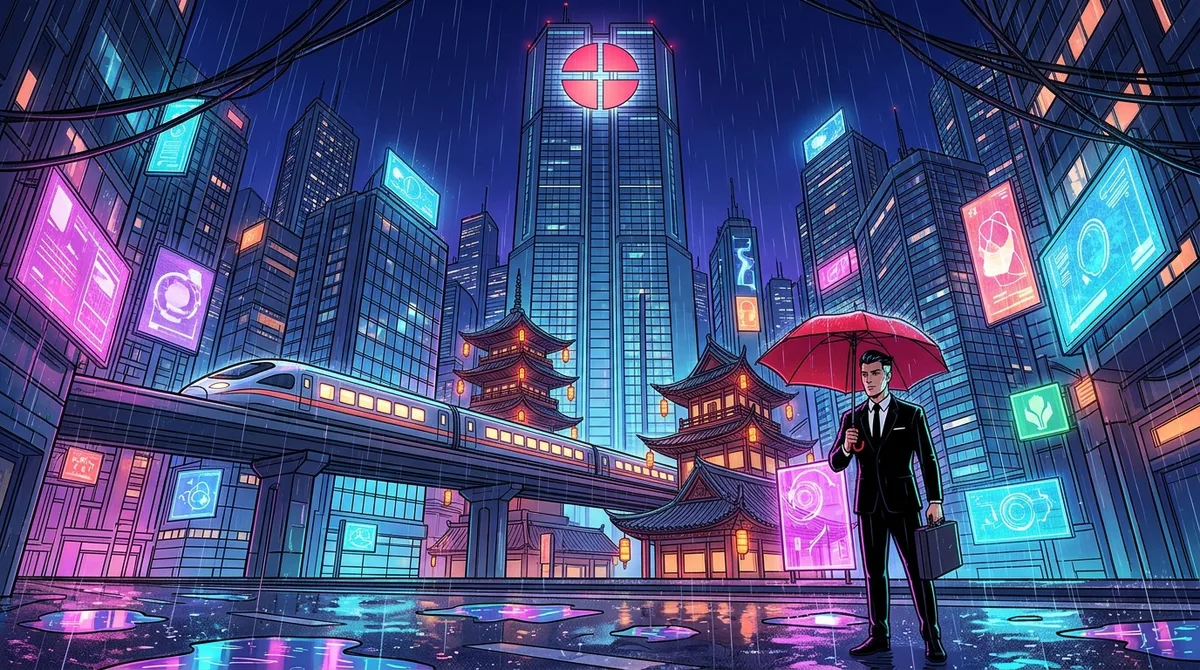
Cyberpunk’s Japanese imagery grew out of 1980s anxiety about money and machines. The genre took shape while writers and readers were fascinated by computerized global economies, and Japan looked like the country winning the tech race. Neon-soaked city streets became the default backdrop for a future that felt uncomfortably close.
A 2024 research article connects that imagery to daily life in the United States, where affordable Japanese technology turned up in ordinary American homes. Admiration for those gadgets sat alongside fear of Japan as an economic threat. The glowing skylines were partly a reaction to what Americans saw on their own shelves.
A 2011 Science Fiction Studies article ties William Gibson’s portrayal of Japan to techno-orientalism and anti-Japanese sentiment during the country’s late twentieth-century economic boom. In other words, some of the futuristic awe came with a sharp edge.
Scholars warn that parts of this imagery leaned on stereotypes, squeezing an entire country into a bundle of neon signs and mysterious tech. That critique matters because it reminds fans that the look borrowed real anxieties about real people.
Yes, and real defense contractors have given the meme fresh fuel. A 2025 exploratory study covered 245 social-media threads containing 19,804 posts about Rheinmetall’s 2023 proposal to protect a planned Ukrainian production facility with company-owned air defense, as reported in the Journal of Geek Studies.
Cyberpunk comparisons were common across those threads. The moment a weapons maker offered to guard its own factory, people reached for neon-soaked dystopias to describe it. Nobody needed a textbook to get the joke.
The reaction was loud and mostly on-side. Initial posts reporting the announcement drew roughly 13.8 likes for every dislike, which is the internet equivalent of a crowd cheering a villain’s big entrance.
Why does this imagery travel so well? It packs a lot into one picture. A company with its own air defense says more about corporate power in a single image than a long report could. Corporate-militarization imagery gives people a fast, memorable way to talk about who holds the real power.
That speed is the whole appeal. You don’t have to explain market power or oligopolies from scratch. You just say “megacorp with its own missiles” and everyone gets the vibe.
Of course, a real firm is not a cyberpunk villain with a laser-eyed CEO. The fiction simply exaggerates what real-world companies can do, and that exaggeration is what makes the frame so handy. Somewhere, a tabletop game master is nodding along.
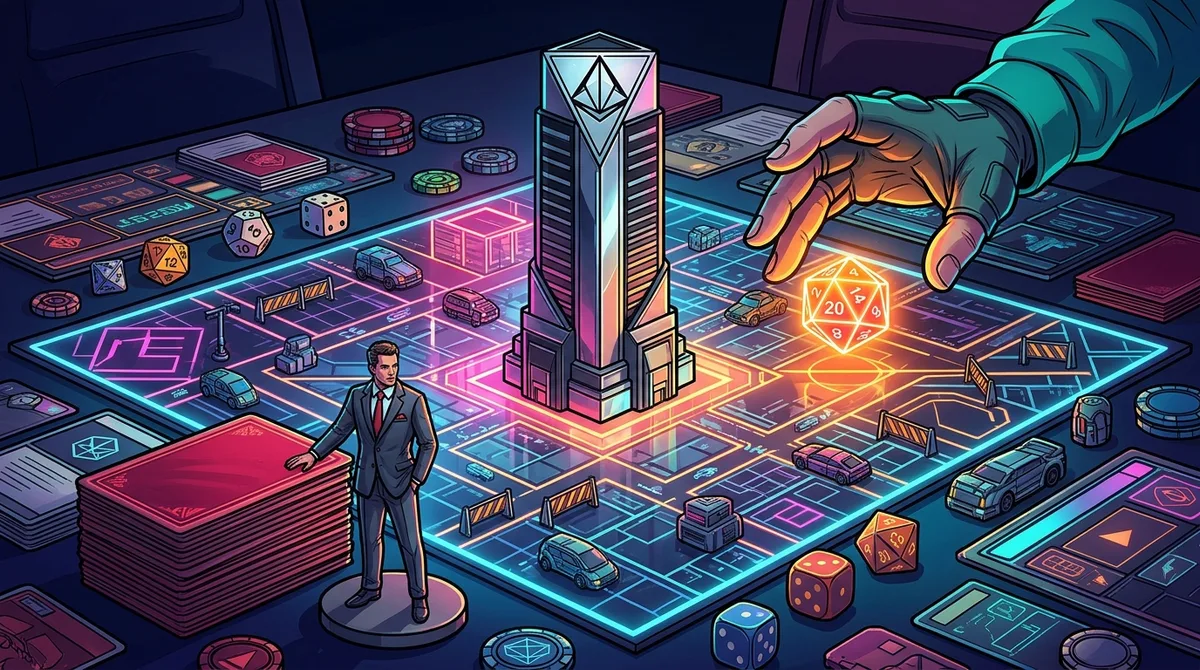
Tabletop role-playing games locked the megacorp trope in place by letting players live inside it. Cyberpunk arrived in 1988 and Shadowrun followed in 1989, and both put corporations at the center of the action. Their settings are packed with corporate enclaves, walled-off company territories where the firm’s rules replace the local ones. Corporate military assets guard those zones, and extraterritoriality means the company answers to no outside authority.
The genre also gave us the corporate samurai, the hired fighter who works for a company the way a feudal warrior once served a lord. It’s a classic cyberpunk trope, and it’s a blast at the table. Players roll dice, pick a corp to work for or double-cross, and sneak past armed guards with cybernetic upgrades.
Games also flip the view from the tower to the sidewalk. Instead of gazing up at the glowing logo, you play the shadowrunner or street-level outsider who pushes back. You steal the data, expose the cover-up and make the giant feel a little smaller. That’s the hook: the villain is enormous, but you get to outsmart it.
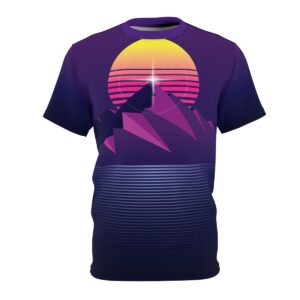
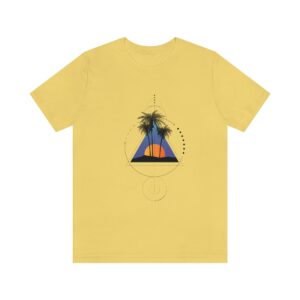
Gamers and synthwave fans carry that spirit into everyday life. A retro graphic tee with a neon palette is an easy way to show you’re part of the crew before the first die hits the table.
Ready to wear the look yourself? Retrowave’s standard unisex graphic tees are 100% Airlume combed and ringspun cotton, though fiber content may vary by color. The fabric is light at 4.2 oz/yd² (142 g/m²) with a retail fit, and the tees run true to size, so your usual size should work.
Want something that looks like a neon billboard came to life? The Blue Rays AOP t-shirt is 100% polyester with a regular fit, and it comes in 4.0 oz and 6.0 oz fabrics. It’s tagless, so nothing itches while you’re grinding through a late-night raid, and it also runs true to size.
Before you check out, compare measurements on the size chart on each product page. Custom orders may take longer to ship than standard orders, so order early if a birthday is coming up. If you’re stuck between sizes, customer support is available by email or through the Contact Us page. Most items can be returned within 30 days of receipt in new condition, so a wrong size doesn’t have to be a total loss.
Start by picking your corp. Standard unisex graphic tees are listed at $27.00 and often go on sale for $22.95. Some tees are listed at $11.99 with a sale price of $10.19, and AOP t-shirts are $32.00, or $27.20 on sale.
Next, check where your package is headed. Retrowave ships internationally to most countries, but shipping costs and delivery times vary by destination, so look at the shipping details before you check out.
You can pay with Visa, MasterCard, American Express, PayPal or other digital payment platforms. Once your order is placed, a confirmation email arrives, so keep it handy in case you need to reference your purchase.
Changed your mind? Order changes or cancellations are possible only within a short window after ordering, and they must be requested through customer service. Once an order is processed, changes may no longer be possible, so move fast.
Want a deal? The newsletter announces special offers and new arrivals, and discounts pop up from time to time. The company also says it sources products from suppliers who adhere to fair labor standards, which is a nice bonus when the gift is for someone you love.
If you want more neon in your life, reach out to Retrowave through the Contact Us page.