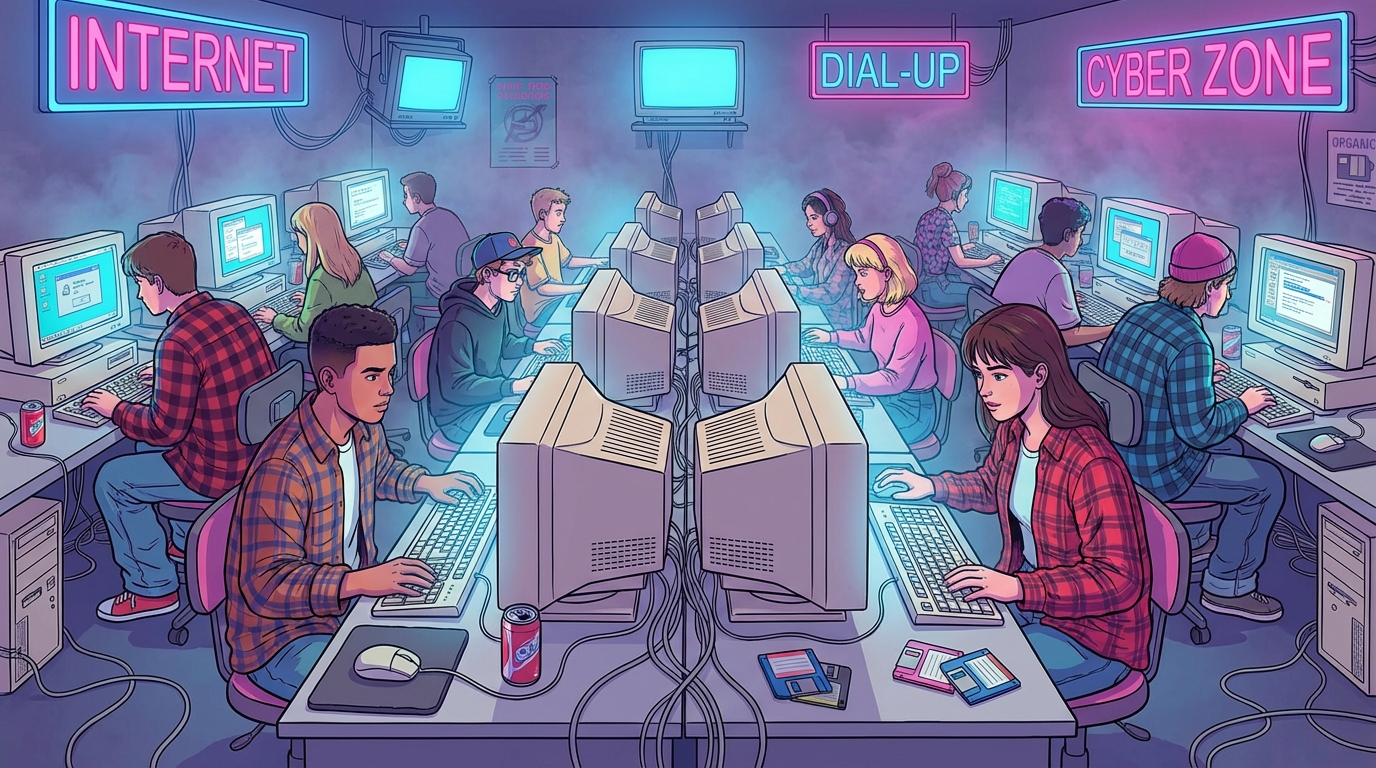
Picture yourself stepping out of the bright sun and into a dimly lit room glowing with neon purple hues and the hum of bulky gray monitors. You aren’t just there for a caffeine fix; you’re entering the pixelated heart of 1990s internet cafe culture, where the air smells like roasted beans and static electricity. Before everyone had a supercomputer in their pocket, these digital dens were the only way to surf the web without your mom picking up the kitchen phone and killing your connection. It was a glorious era of clacking mechanical keyboards and the sweet, screeching symphony of dial-up modems.
Whether you were a hardcore gamer looking to dominate a local area network or a curious soul sending your very first email, these “third spaces” were your portal to the future. You’d trade your pocket change for an hour of freedom, navigating primitive chat rooms while sipping a lukewarm soda under flickering fluorescent lights. It was the ultimate mashup of analog social vibes and early digital chaos, creating a community that felt like a real-life sci-fi movie. You didn’t just go online; you traveled to a destination where the possibilities felt as infinite as a synthwave sunset.
Before you could carry the entire sum of human knowledge in your pocket, you had to hunt for a glowing terminal in the back of a smoky coffee shop. The early 90s birthed a unique vibe where the smell of roasted beans mixed with the ozone of bulky CRT monitors and the hum of cooling fans. In 1991, pioneers in San Francisco started installing coin operated terminals that let you dial into bulletin board systems while sipping your latte. It was the ultimate cyberpunk fantasy come to life, turning a regular afternoon snack into a high tech mission through the digital frontier. These stations were the humble ancestors of our always connected world, proving that people actually wanted to socialize while staring at green text on a black screen.
The movement truly went global when iconic locations opened their doors in 1994, blending high fashion with high speed dial up. Imagine walking into a room filled with neon lights and translucent plastic, where the futuristic chirping of modems provided the soundtrack to your digital journey. It was a place to see and be seen, acting as a third space for hackers and curious newcomers alike to explore the World Wide Web. You weren’t just checking your email, you were participating in a cultural revolution that felt like stepping into a scene from a synthwave music video. These digital dens transformed the internet from a lonely hobby into a shared social experience that defined an entire decade.
By the late 90s, these cafes became the ultimate hangout spots for gamers and early web surfers looking for a fix of that sweet, sweet bandwidth. You would grab a soda, settle into a creaky chair, and lose yourself in a world of pixelated graphics and chat rooms. It was the peak of the retrowave aesthetic, where everything felt new, exciting, and just a little bit glitchy. These spaces bridged the gap between our analog past and the hyper connected future, creating a community of pioneers who didn’t mind waiting five minutes for a single image to load. They were the neon heart of the 90s, proving that the best way to experience the future was together in a room full of glowing screens.
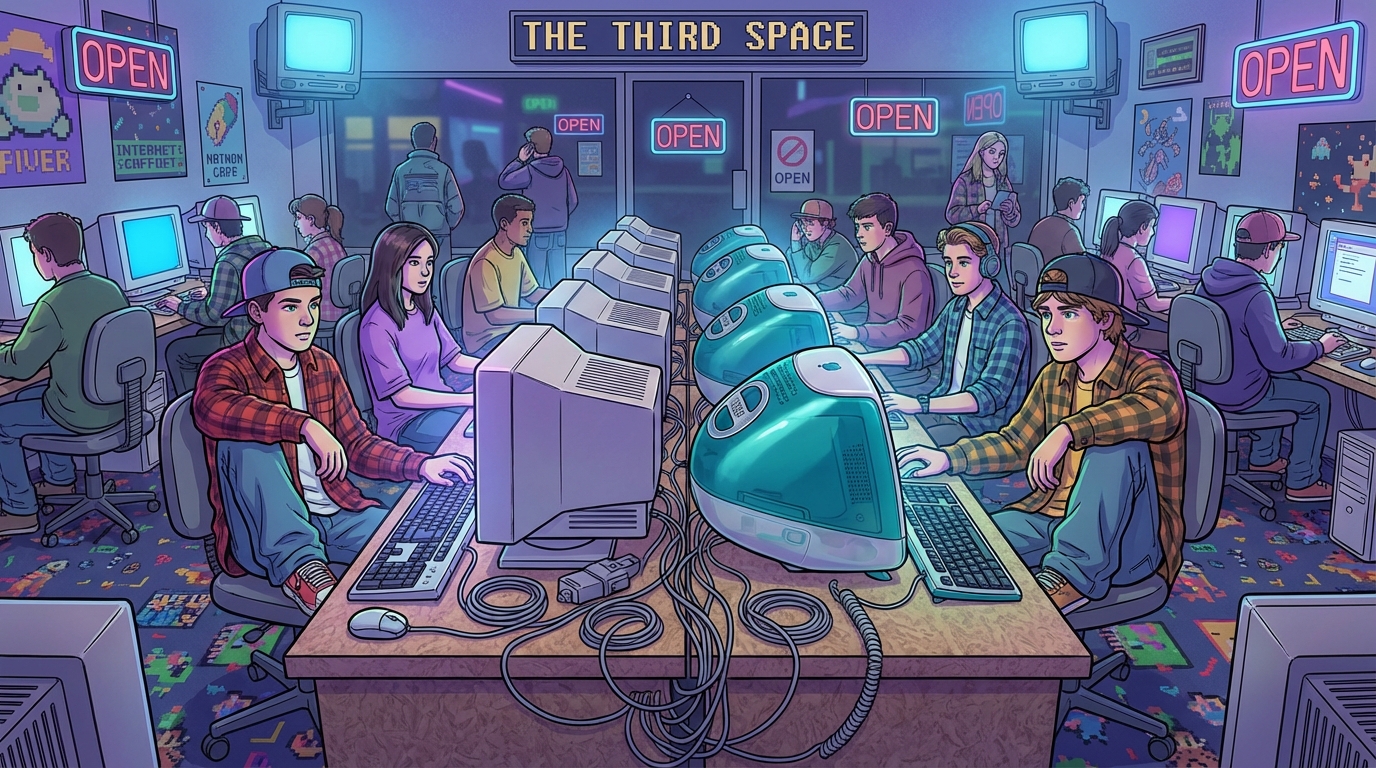
Imagine stepping into a dimly lit room where the air smells like roasted coffee and warm circuit boards. You are greeted by a glowing sea of colorful computers and neon signs that make the whole place look like a scene from a low-budget cyberpunk flick. This was the ultimate hangout spot, a digital sanctuary where you could escape your parents and finally surf the web at speeds that felt like light travel compared to your dial-up at home. It was a world of translucent plastic and chunky keyboards, providing a cozy corner for anyone who felt like a futuristic pioneer in a baggy flannel shirt.
These cafes became the legendary third space where your online guild members finally turned into real people over a shared plate of fries. You could spend hours hunched over a flickering monitor, chatting with strangers across the globe while the hum of cooling fans provided a soothing lo-fi soundtrack. It did not matter if you were there to dominate a multiplayer shooter or just check your email, because you were part of a physical community built on digital dreams. Every glowing screen was a portal to a new frontier, and for a few dollars an hour, you were the king of the information superhighway.
Step inside a dimly lit sanctuary where the air is thick with the scent of salty snacks and the hum of massive CRT monitors. You are surrounded by a sea of beige plastic and glowing neon lights that make the room feel like a scene straight out of a low-budget cyberpunk flick. This was the original social network, a place where your online identity was forged in a crowded room rather than a lonely bedroom. Everyone is hunched over their keyboards, their faces illuminated by the flickering glare of early 3D graphics. It was loud, it was cramped, and it was the coolest place on the planet for anyone with a digital pulse.
The real magic happened when the sun went down and the late-night LAN parties kicked into high gear. You and your friends would huddle together, shouting callouts over the clicking of mechanical mice as you tried to plant a bomb in your favorite tactical shooter. There was no such thing as lag when your opponent was sitting three feet away, close enough for you to see their frustration when you pulled off a cheeky headshot. These marathons were fueled by cheap soda and the shared adrenaline of a perfectly executed strategy. You weren’t just playing a game, you were part of a living, breathing community that turned pixels into a high-stakes spectator sport.
This era of plastic-cased towers and tangled ethernet cables was the secret birthplace of the modern eSports phenomenon. It transformed gaming from a solitary hobby into a loud, communal ritual that defined an entire generation of tech lovers. You learned how to talk trash in person, share secret cheat codes, and celebrate victories with high-fives that actually landed. The internet cafe culture was a bridge between the analog world and the digital frontier, wrapped in a retrowave aesthetic that still feels futuristic today. It was a glorious, neon-soaked mess that proved gaming is always better when you have a crowd cheering behind you.
The 1990s internet cafe was a glorious neon-soaked bridge between the analog past and our hyper-connected future. You probably remember the distinct smell of burnt coffee and ozone, paired with the rhythmic clicking of mechanical keyboards under dim fluorescent lights. These hubs were the original “third space” where you could escape reality to explore a pixelated frontier of chat rooms and early web forums. It was a time when the digital world felt like a secret club, accessible only through a glowing CRT monitor and a handful of loose change. This era proved that technology was always meant to be a social experience rather than a lonely one.
Even though high-speed broadband eventually killed the need to visit a physical shop for your digital fix, the aesthetic of that period is permanently etched into our collective memory. You can still see the influence of those clunky beige towers and low-poly graphics in today’s retrowave art and vaporwave soundtracks. The DIY spirit of those early cyber-explorers paved the way for the massive online communities and gaming marathons you enjoy today. We traded the sticky communal mice for sleek smartphones, but the desire to connect over a shared screen remains exactly the same. That chunky, plastic-filled era wasn’t just a phase, it was the foundation of your entire online life.
Looking back at those dimly lit rooms filled with glowing screens feels like peering into a cyberpunk dream that actually came true. You were part of a generation that turned logging on into a legendary social event, complete with lag spikes and pixelated avatars. While you might not miss the screeching sound of a dial-up modem, you definitely miss the magic of discovering the web alongside your friends. The internet cafe might be a relic of the past, but its legacy of community and digital curiosity lives on every time you hit that “join” button. Keep those neon dreams alive as you explore the vast, high-speed world that those 90s pioneers built for you.
These were the ultimate digital hangouts where you traded your spare change for a ticket to the world wide web. Think of them as neon lit portals filled with chunky monitors and the glorious screech of dial-up modems. They were the only place to get your geek on without your parents accidentally killing the connection by picking up the landline.
Back in the day, having a home computer was a luxury and the internet was painfully slow. Internet cafes gave you high speed access and a cool place to hang out away from your boring living room. It was the only way to surf the web while surrounded by fellow gamers and enough caffeine to power a small city.
Imagine a dark room glowing with purple neon and the hum of a hundred cooling fans. It felt like stepping into a low budget sci-fi movie where the air smelled like roasted coffee and static electricity. You had the perfect mix of analog social vibes and early digital chaos while sitting under flickering fluorescent lights.
You were probably dominating a local area network game or exploring primitive chat rooms to talk to strangers across the globe. Many people also used their hour of power to send their very first email or explore the wild west of early websites. It was a digital playground where every click felt like a mission into the great unknown.
These were the granddaddies of the modern internet cafe, starting out as coin operated terminals in San Francisco coffee shops. You could sip a latte while dialing into bulletin board systems to leave messages for other tech pioneers. They turned a simple snack break into a cyberpunk fantasy long before everyone had a smartphone.
While most people carry a supercomputer in their pocket now, the spirit of the cyber cafe lives on in high end gaming centers. They still provide that essential third space where you can escape reality and game with your squad in person. Nothing beats the feeling of a physical community, even if we don’t have to listen to the dial-up scream anymore. This evolution through video games continues to shape how we interact with digital culture today. For those interested in the history of these venues, SF Net in San Francisco and Cyberia in London stand as landmark examples of how these spaces first captured the public imagination.