Most 1980s music video effects came from a mix of practical camera tricks, analog video processing and early computer graphics, not a sudden leap into all-digital filmmaking. You didn’t need a fancy lab for that spacey look. Rotating prisms in front of a lens could multiply a singer into a whole crowd, while smoke, colored gels and a patient crew did the rest. Then computers crashed the party. In 1981, Quantel revealed its Digital Paint Box, and the first buyer paid $157,800 for the system.
Money was the real boss, though. A 1983 TIME report put the average music video budget at $20,000 to $40,000, and most clips were shot in one or two days. That rush pushed directors toward bold, cheap tricks that looked like they cost a fortune. It’s also why so many of these clips still feel like tiny sci-fi movies you can’t quite shake.
Three kinds of tricks stacked on top of each other gave 80s music videos their look: practical camera tricks, analog video processing and early computer graphics. Nobody flipped a switch to all-digital filmmaking. Instead, crews layered old-school tools with new gadgets, like a classic arcade cabinet that suddenly unlocks a few cheat codes.
Speed was the real driver. The Los Angeles Times reported that in May 1982, 28 of the Billboard Top 100 singles had promotional videos, and the number kept climbing. Every new clip needed a fresh look, and nobody had time to wait around for one.
Tobe Hooper, the director of Poltergeist, shot Billy Idol’s “Dancing with Myself” in two days, edited it in a week and saw it air two weeks later. That’s a faster turnaround than most sitcom seasons. Hooper’s schedule wasn’t unusual for the era, and you can see the rush in the footage.
With short shoots and tight budgets, directors reached for cheap tricks that looked expensive. A double exposure could make one singer look like two. Reversed footage, a strip of colored plastic over a light or a flash of negative image could turn a plain room into another planet.
Editing time was costly too, so many effects were planned before the cameras rolled. Crews thought about the trick first and the story second, and that mindset is a big reason these clips still feel like tiny sci-fi movies.
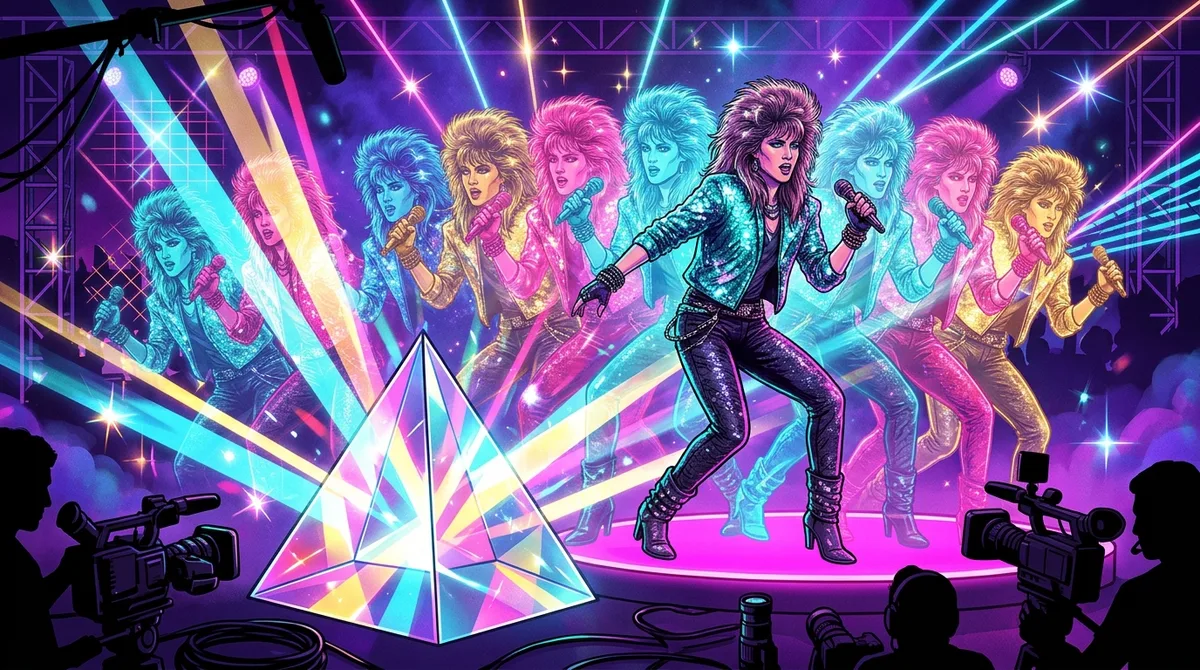
Prisms, slit-scans, split screens, video feedback and inverted colors all created the look right on set, with no editing suite needed. Prisms were the easiest trick to pull off. A prism unit sat in front of the lens and split one singer into a whole crowd, like a cheat code that copies your character.
The Science Museum Group describes an ATV optical-effects unit with six interchangeable prisms. You placed it in front of the camera and turned a crank to create multiple or concentric images. The museum notes that this effect was frequently used in music videos from the 1960s through the 1980s, so it was a staple long before the 80s hit their stride.
Other tricks were just as weird and just as cheap. Here are a few favorites:
Each of these depended on timing and patience. A feedback loop could go from cool to chaotic in seconds, so crews had to find the sweet spot by eye. Nobody had a preview button that could fix a bad take later.
That’s why these clips feel so hand-made. Every trick was visible in the frame, and the bizarre shapes and glowing edges still look like they came from another dimension.
VHS tape, CRT television screens, film grain and lens flares gave 80s videos their grainy, glitchy look, and filmmakers often kept those flaws on purpose. The result felt warm, fuzzy and a little bit like a dream.
VHS tape was soft and smeary. Each copy lost a bit of sharpness, so edges blurred and colors bled into each other like a watercolor left out in the rain. Tracking problems could tear a wobbly band of static across the screen, and tape noise added a constant fuzzy snow. Nobody asked for those glitches, but they became part of the decade’s sound and style.
Scan lines came from the TV itself. A cathode-ray tube painted the picture one thin horizontal line at a time, so faint stripes showed up if you looked closely. Many editors copied that look on purpose, laying lines over clean footage so it seemed to be playing on a living room set. That was an early retro filter, long before anyone called it that.
Film grain and soft focus added a dreamier, more cinematic feel. Grain is the speckled texture of film stock, and it made a scene feel gritty and lived-in. A slightly soft lens smoothed faces and skylines, so a singer in a smoky room looked more like a memory than a real person.
Lens flares and light leaks were the final touch. A bright lamp hitting the lens sent streaks and halos across the frame, while stray light leaking into the camera washed the edges in orange or pink. Directors used those glows to turn a plain set into a hazy dream or a neon-lit spaceship deck, much like the bloom effect in a favorite retro game.
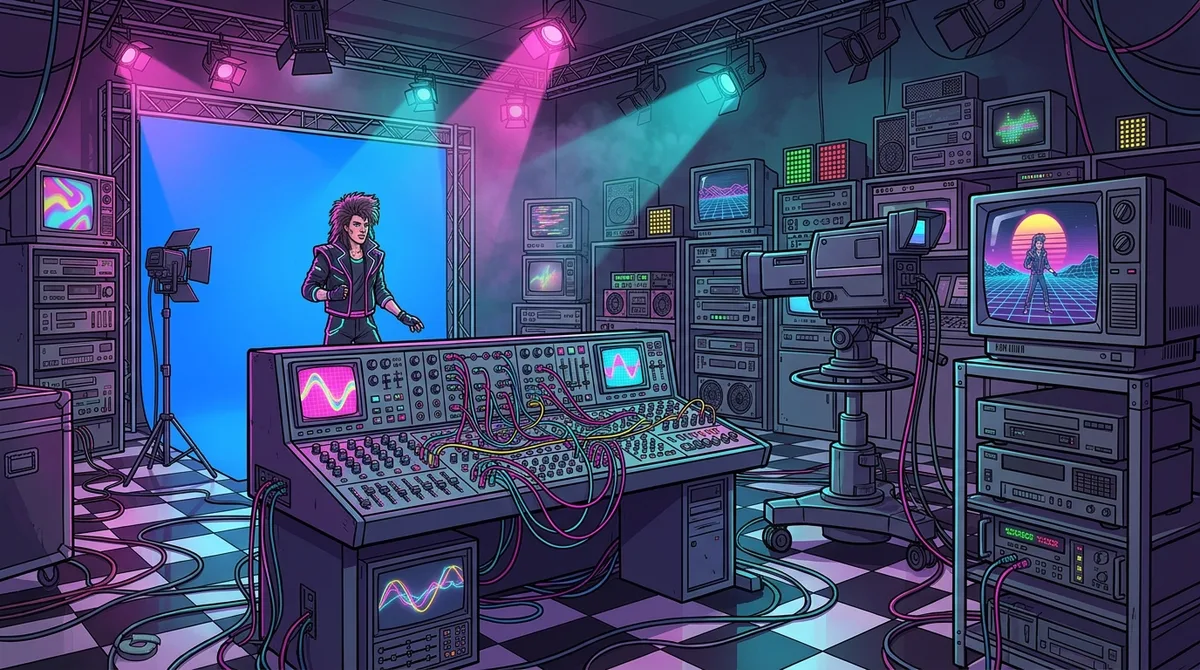
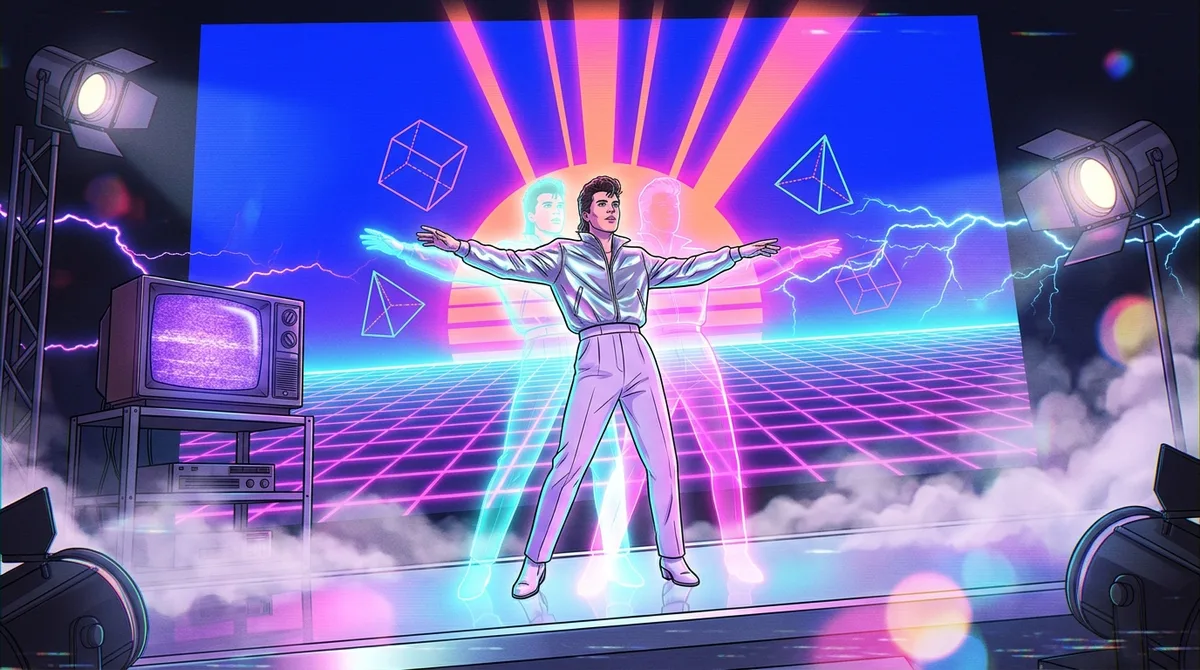
Video synthesizers created and warped color and shapes in real time, while chroma keying swapped a solid background for a new picture. Together they gave 80s clips their bold colors and surreal layers.
A video synthesizer worked like a keyboard for pictures. Instead of playing notes, you turned knobs and watched swirling color bars, wavy shapes and glowing patterns shift on screen. A 1987 demonstration of the Fairlight CVI Plus runs 8 minutes and shows mirror effects, psychedelic colorization, picture freezes and live paintbox work.
Digital video effects systems did similar magic on live footage. A Computer History Museum document describes them as a real-time frame buffer that could zoom, reposition or freeze frames, and says they typically cost $300 per hour per channel.
Chroma keying was the trick that could put a performer anywhere. You stood the singer in front of a solid color, usually blue or green, and the machine replaced that color with another image. One minute the band was in a bare studio, and the next they were floating over a desert or a city of chrome towers.
Keyframed opacity handled the transitions. Editors set a starting point and an ending point for how see-through a layer was, so an image could fade in over the band and melt away smoothly instead of cutting hard. Ghostly layers drifting between shots were a big part of the dreamy feel.
Layering reached its peak by 1985, when Dire Straits’ “Money for Nothing” mixed computer animation with live performance footage and partly rotoscoped animation, made with a Bosch FGS-4000 and a Quantel Paintbox.
Neon glow and gradient titles came from stacking color effects. A bright letter sat on top of a colored outline, a soft halo sat behind it, and a fill that blended from pink to purple finished the job. It looked like the words were lit from inside, and that glowing sign look still shows up in retro-inspired edits today.
Computers first showed up in 80s music videos in 1981, when Quantel revealed the DPB 7000 Digital Paint Box. The first buyer paid $157,800 for the system, so only well-funded studios could play with it at first.
By 1982, the Paintbox could mask images and cut out shapes, which let an editor lift a singer out of one shot and drop them into another. A 1983 upgrade turned it into a full painting, graphic-design, typesetting, photo-manipulation and animation system. Using it cost about $250 an hour, so every minute spent painting over a video frame added up fast.
Frame-freezing gear sat in many of the same edit suites. A shot could stop cold, like a game pausing on a boss, and then start again with a new color wash.
Vector and wireframe graphics pushed the futuristic look even further. Wireframe drawings show only the edges of a shape, so a cube or a mountain range looks like a glowing grid of neon lines. Vector graphics use crisp, clean strokes instead of soft pixels, which suited synth-heavy songs perfectly. You’ll often spot these looks in:
The Middlesex University record of “Money for Nothing” credits Ian Pearson and Gavin Blair with its animation. Their work mixed computer-generated scenes with live footage, so the band seemed to play inside a machine. It’s a perfect example of the decade’s tiny sci-fi movies, built one careful frame at a time.
Budgets decided which effects made it onto the screen, and most crews picked the cheapest trick that still looked wild. A 1989 report said the average video cost about $25,000 in the early 1980s, while most videos at the time of that report ran $50,000 to $125,000. Early clips were built on tight money, so every dollar had to pull its weight.
Computer work was a different league. Paintbox time cost about $250 an hour, so an editor couldn’t just noodle around with a frame like a button-mashing rookie. Crews sketched their shots, counted frames and tested ideas on set, so the expensive hours went to finishing touches instead of experiments.
That’s why so many clips leaned on in-camera tricks and analog gear. A prism unit, a strip of colored plastic or a video feedback loop cost little and could be set up in an afternoon. Nobody needed a fancy suite to make a singer look like a whole crowd of chrome robots.
Cheap didn’t mean boring, either. Directors learned to get maximum effect from minimum gear, and that scrappy, make-it-work energy is a big reason these clips still feel like tiny sci-fi movies with a tiny budget and a whole lot of heart.
You can recreate the 80s look today by layering a few simple effects in almost any video editor, as long as you hold back on the rest. Most common editing programs include retro presets and overlay packs, so you can start with ready-made pieces and tweak them to fit your shot.
Resist the urge to stack every trick at once. The original crews planned their bold looks carefully, so pick two or three effects for each shot and let the rest stay off screen.
Ready to try the look yourself? Start with a short clip you already love and watch it twice. The first time, just soak in the neon. The second time, count the tricks: a prism copy, a glowing edge, a ghost layer, a scan line.
Then grab a 10-second clip of your own and give it only one effect. Add grain at low opacity and stop there. Play it back on your phone and decide whether it feels like a worn-out rental tape or a rough video call. Tweak it until it feels right, then add a second effect and repeat the test.
For more inspiration, search for the terms the British Film Institute says video commissioners used in the 1980s: performance, concept and narrative video. Each style leaned on effects in its own way, so compare a few clips from each and notice which tricks keep showing up.
If you can get to Luxembourg, the exhibition “Video Killed the Radio Star: The 1980s and Their Cultural Echoes” at Mudam runs from June 12 to October 11, 2026. Seeing these looks on a big screen beats any phone clip.
Last tip: save each test as its own file, something like “80s-test-v1” and “80s-test-v2.” Your future self will thank you when you want to compare the prism shot with the grainy one.