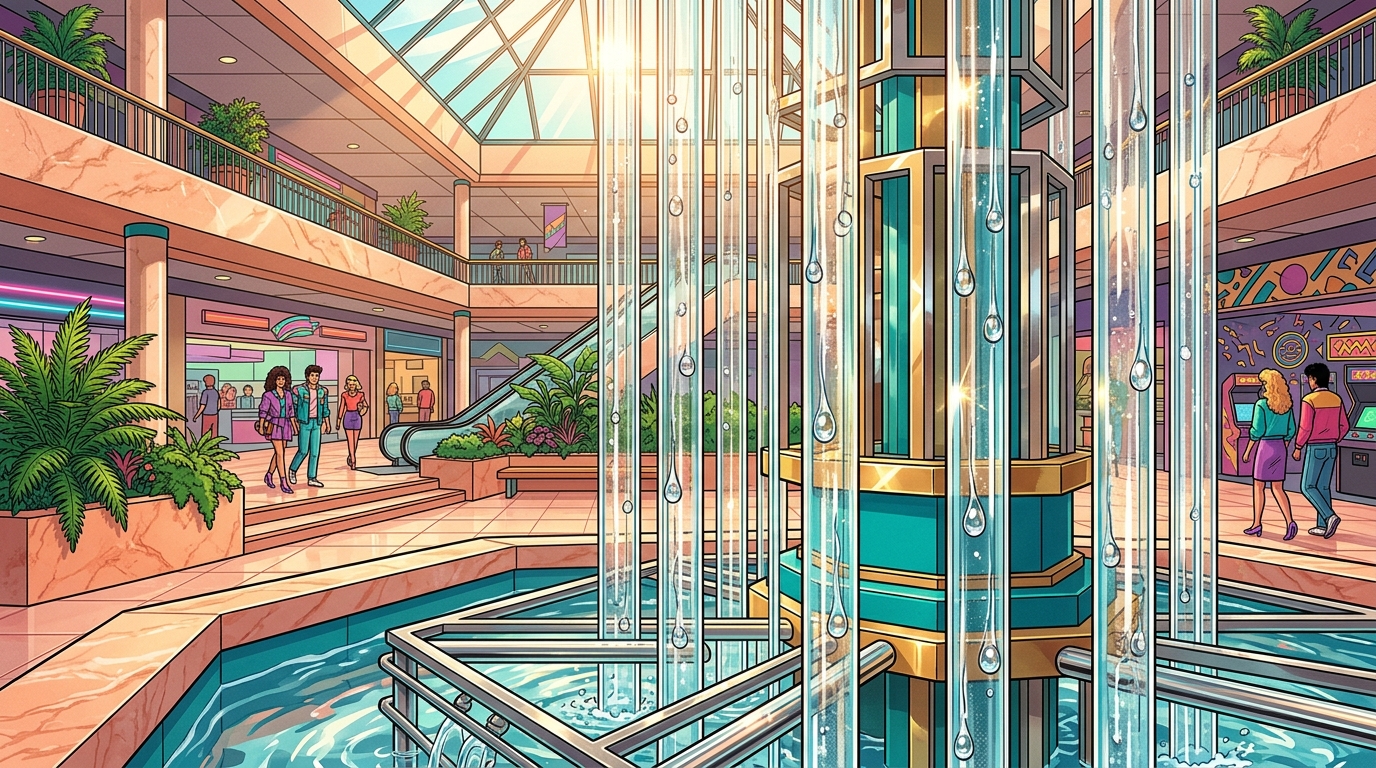
Picture yourself rocking a neon windbreaker, gripping a lukewarm Orange Julius, and staring intensely at that glowing water feature near the food court. You aren’t just killing time before the movie; you’re witnessing a high-stakes battle of mall fountain physics happening right before your eyes. It’s a world where water tries to decide if it wants to be a smooth, glass rod masterpiece or a chaotic splash zone that ruins your new kicks.
The secret sauce behind those mesmerizing arcs is all about controlling the flow without lagging the real-life frame rate. When the water looks like a solid, motionless beam of light, you’ve entered the legendary realm of laminar flow. It’s basically the fluid version of a perfect speedrun, where every drop follows the leader in a smooth, synthwave-inspired dance. When things get rowdy and frothy, the physics have shifted into turbulent mode, turning the fountain into a glorious, white-noise-generating beast.
You know that feeling when you are wandering through a neon-lit atrium in 1987 and you spot a stream of water so perfect it looks like a translucent plastic tube? That is not magic or a glitch in the simulation, it is actually the result of engineers obsessively lowering the Reynolds Number of the fountain. By smoothing out the chaos and making sure every single water molecule travels in a perfectly straight line, they eliminate all that messy splashing and white foam. The result is a liquid arc that looks like a solid glass rod frozen in time, capturing that pristine vaporwave aesthetic we all crave. It is basically the ultimate high-definition setting for real-life fluids, turning a simple mall feature into a mesmerizing piece of functional art.
Achieving this level of chill requires some serious technical wizardry hidden behind those marble planters and brass railings. Designers use special nozzles packed with tiny tubes to force the water into parallel layers, preventing any turbulent vibes from ruining the flow. When the water exits the jet, it is so stable that it does not even break apart into droplets until it hits the basin floor. You can reach out and touch it, feeling a strange, slick sensation that is way more satisfying than a regular garden hose. It is the physics equivalent of a perfectly looped lo-fi beat, providing a smooth visual rhythm that keeps the mall atmosphere feeling totally zen.
The glass rod effect is the crown jewel of retro-futuristic mall design because it defies your expectations of how liquids should behave. Instead of a noisy, splattering mess, you get a silent and crystal-clear stream that reflects the pink and blue neon lights of the food court perfectly. This lack of friction and air resistance means the water moves with a surreal grace, looking more like a computer-generated sprite than an actual physical substance. It is the kind of detail that makes you want to put on your favorite synthwave track and just stare into the void of the fountain for an hour. Engineering might be about math, but in the mall, it is all about creating that flawless, glassy vibe.
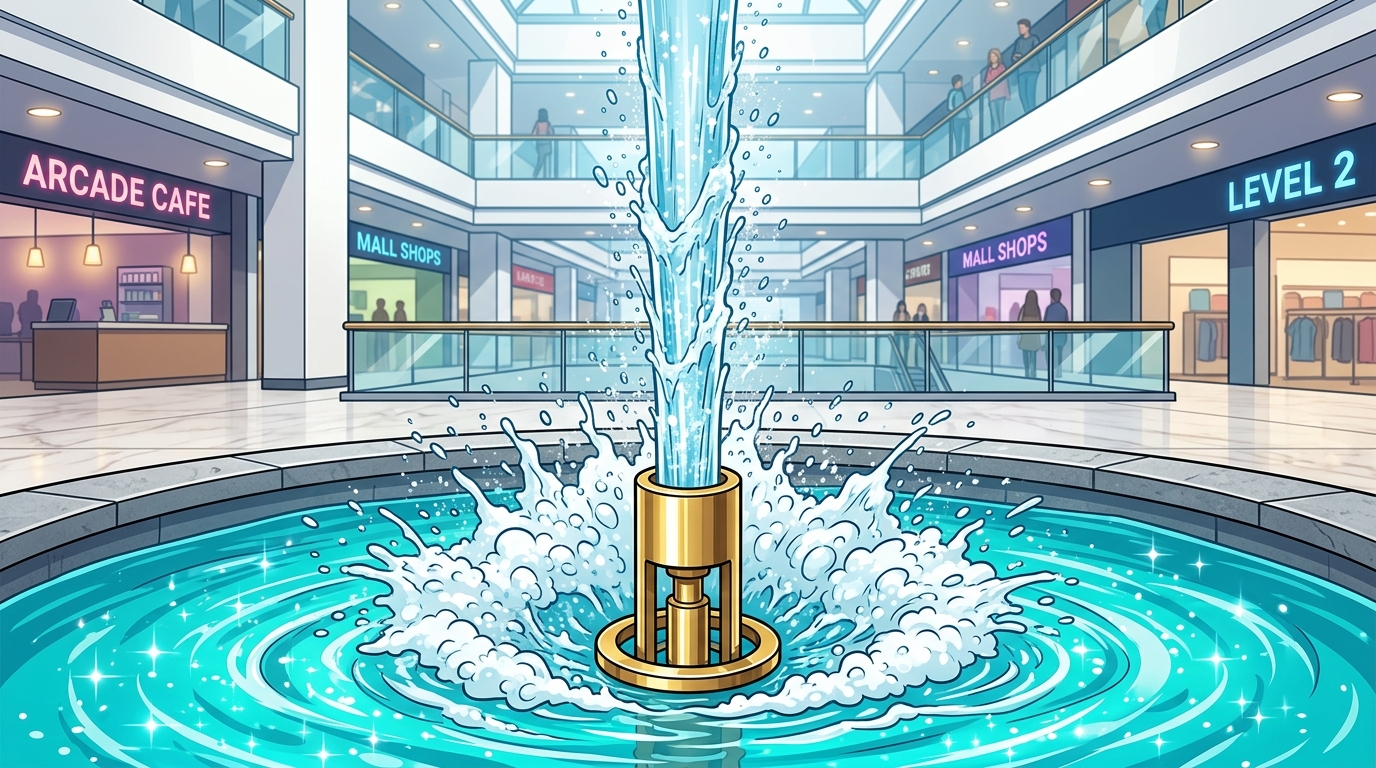
The magic happens when you look up at those towering pillars of water and realize it is all just a clever dance between speed and pressure. According to the Bernoulli Principle, as the water speeds up through the tight plumbing of the fountain, its internal pressure actually drops to trade that energy for pure velocity. This high pressure nozzle vibe is exactly what sends a stream of recycled mall water soaring toward the skylights while you hunt for a new cassette tape. It is a high stakes game of physics where the pump works overtime to ensure every drop hits its peak height with total precision. You can almost feel the kinetic energy vibrating through the tile floor as the water prepares for its big launch into the neon light.
The secret to that perfect glass rod look lies in how the nozzle shapes the flow into a smooth, laminar masterpiece. By forcing the water through specialized high-pressure nozzles, engineers eliminate all the chaotic turbulence that usually makes a garden hose spray look messy. This creates a uniform arc that looks so still and solid you might mistake it for a curved piece of plastic under the food court lights. It is the peak aesthetic for any synthwave fan, offering a satisfying visual loop that feels like a glitch in reality. When the nozzle is tuned just right, the water stays perfectly transparent until it finally crashes back into the turquoise pool below.
Watching these fountains is like seeing a physical manifestation of a lo-fi hip hop beat right in the middle of the shopping center. The designers use the Reynolds Number to calculate exactly how to keep the water from turning into a frothy mess before it reaches the top of its arc. This technical wizardry is why the water looks so crisp against the backdrop of indoor palm trees and mirrored pillars. It is a total sensory experience that combines mechanical engineering with the dreamy, nostalgic vibes of a 1980s afternoon. You do not need to be a scientist to appreciate the way these high pressure systems turn basic plumbing into a liquid work of art.
The magic happens when you stare at those glowing neon streams and realize the water isn’t actually a solid glass rod. Even though the fountain pump is trying its hardest to keep things smooth, physics has a different plan for that liquid aesthetic. Surface tension acts like a tiny internal bungee cord that wants to pull the water into the tightest shape possible. This tension creates a series of ripples that eventually pinch the stream into those iconic, shimmering diamonds. It is basically nature’s way of glitching the system to create a rhythmic strobe effect without any fancy electronics.
You can think of this process as the original lo-fi beat generator for the entire food court. As the stream stretches out, it hits a breaking point where it can no longer stay a single line and collapses into a sequence of perfect spheres. This transformation, known as Plateau-Rayleigh instability, is what creates that crisp, splashing white noise that echoes off the marble floors and potted ferns. It is a mathematical certainty that turns a simple hydraulic arc into a sensory masterpiece of retro engineering. Watching these droplets fall feels like watching a slow motion video game sprite moving through a vaporwave dreamscape.
The mall fountain stands as the ultimate monument to functional synthwave art, blending high-tech hydraulic engineering with the peak of lo-fi chill. You have seen how those glass-like laminar streams and bubbly white-water crashes are more than just background noise for a food court. They are carefully calibrated physics experiments designed to soothe your brain while you hunt for the latest cassette tape or neon windbreaker. This marriage of fluid mechanics and 80s aesthetics creates a sensory sanctuary that feels like stepping directly into a retro-futurist screensaver.
Every time you toss a penny into that shimmering turquoise basin, you are participating in a masterpiece of public infrastructure. The way the water catches the glow of the overhead skylights while holding a perfect laminar arc is a testament to the power of the Reynolds number working in your favor. It is a technical achievement that does not brag, opting instead to provide a steady soundtrack of white noise for your Saturday afternoon hangouts. You can walk away knowing that these bubbling relics are the true heart of the mall, keeping the wishing magic of the 1980s alive through every perfectly timed splash.
Cherish these liquid time machines because they represent a specific moment when architecture and physics decided to just vibe together. Whether it is the smooth flow of a glass rod nozzle or the chaotic energy of a turbulent mist, the mall fountain remains the undisputed king of retro-cool engineering. You do not need a degree in fluid dynamics to appreciate the way these systems turn simple H2O into a neon-soaked masterpiece of urban design. Keep that synthwave playlist looping in your headphones and let the steady rhythm of the pumps remind you that some things are just built to stay cool forever.
That glass rod effect is what we call laminar flow, where water molecules act like they are in a perfectly synchronized dance. We achieve this by smoothing out all the chaos until the stream looks like a solid, motionless piece of neon-lit art. It is basically the high-definition, lag-free version of water physics.
When the water gets rowdy and frothy, it has officially entered turbulent mode. This happens when the physics get a bit too chaotic for the molecules to stay in line, turning your smooth stream into a white-noise-generating beast. It is the fluid equivalent of a glitchy, low-resolution frame rate compared to the smooth laminar setting.
Professional designers use secret technical wizardry involving special nozzles packed with tiny tubes to force the water into parallel lines. By obsessively lowering the Reynolds Number, they eliminate the messy splashes and foam. This technical sorcery happens behind the scenes so you can enjoy that pristine vaporwave aesthetic while you sip your Orange Julius.
It is not a glitch, it is just peak engineering performance. When every drop follows the leader in a straight line, the water stays perfectly contained without any mess. You are just witnessing the ultimate speedrun of fluid dynamics where everything goes exactly according to plan.
The Reynolds Number is the boss level of fountain physics that determines if the water is chill or chaotic. By keeping this number low, experts ensure the water stays in that legendary laminar state. It is the key to turning a simple food court feature into a mesmerizing piece of functional art.
Hitting that level of chill is actually pretty hard because normal hoses are full of turbulent energy. You would need some serious hardware, like specialized nozzles and flow stabilizers, to get that 1987 atrium vibe. Without the right gear, your water is just going to stay in the standard, splashy resolution.