Demoscene history kicks off in the mid-1980s, when home-computer owners started tacking flashy signature screens onto the games they had cracked. Those early crack intros were the scene’s business cards, a little neon flex that said “we were here” before the actual game loaded. Nobody planned a whole culture out of it. The bragging, the rebellion, and pure curiosity about what these beige boxes could do slowly turned those screens into standalone works, and then into an entire scene. The shift happened gradually, so some groups kept cracking and making demos side by side for a while. It’s like a mixtape that got recorded over, one layer at a time.
Today the Finnish Postal Museum describes the demoscene as an international community making real-time audiovisual presentations that mix programming, graphics, and sound. Pretty fancy for a bunch of kids trading floppy disks! The scene got its official stamp of approval in 2020, when Finland added it to its National Inventory of Living Heritage. By April 2026, Norway had become the eighth country to recognize it as national intangible cultural heritage. Not bad for a hobby that once ran on photocopied flyers and late-night phone calls. Its signature challenges, the 64k and 4k intro competitions, cap file sizes at 65,536 and 4,096 bytes, so every glowing animation and throbbing soundtrack has to fit inside a tiny data box.
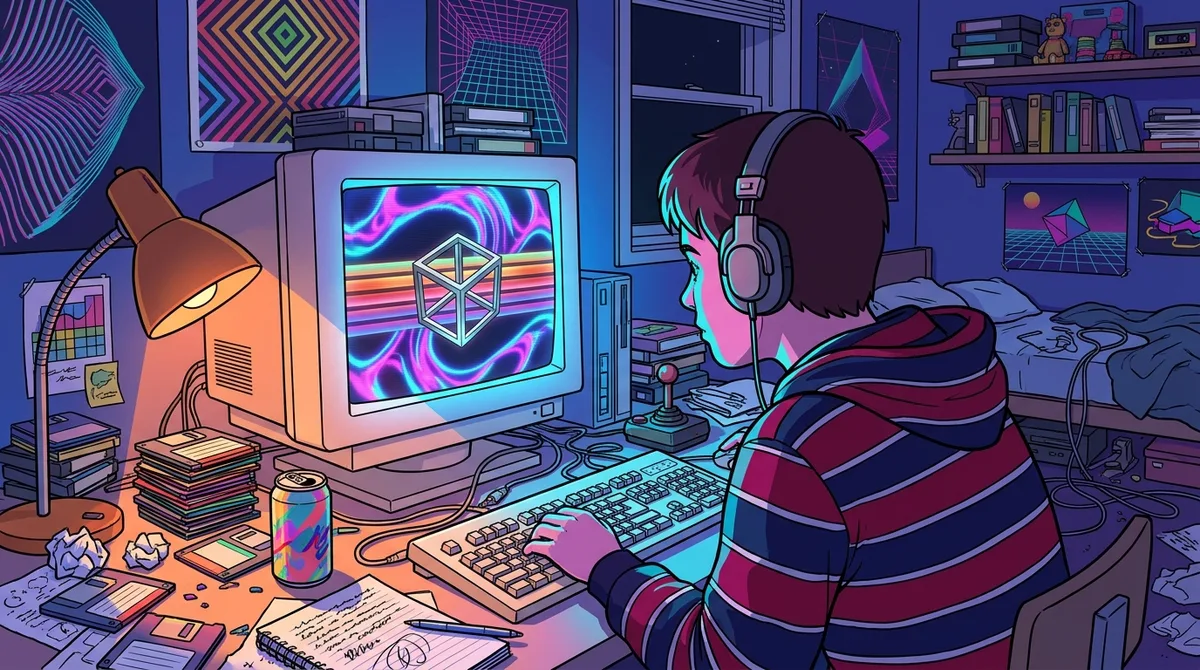
The demoscene grew out of 1980s home-computer culture, mostly from people who cracked games and then got carried away decorating them. Picture a bedroom lit only by a CRT glow, a stack of floppy disks, and a kid who just beat a game’s copy protection and wants the whole world to know it.
Cracking meant removing the locks that stopped people from copying a game. Crackers wanted credit for the job, so they added a flashy screen before the game started, usually with their handle, their group name, and a bit of scrolling text. Those screens were the early version of a scene calling card. Some crackers got so into making them that the screen started to matter more than the game underneath. Bragging rights, a little rebellion, and plain curiosity about what these machines could do all pushed in the same direction.
Researchers describe the first demoscene groups and crack intros as appearing in the mid-1980s, when those signature screens began evolving into something more. It’s the moment a sticky note turned into a poster. A 2014 peer-reviewed history of the scene traces that path, showing how the intros slowly gained their own identity.
The machine most tied to this early era was the Commodore 64. Its sound chip and graphics gave coders a surprising amount of room to play, and the 64 became the scene’s home base for years. A Norwegian heritage account names the C64 as the early machine of the scene, and it also records one of the key gatherings of the period.
That gathering was a copy party in Stjørdal, Norway, in autumn 1988. Organized by Razor 1911, Abnormal, and The Cartel, it was a real-world meetup where people swapped software, traded disks, and showed off what they had made. In the pre-internet days, a room full of people with floppy disks was basically the group chat, the forum, and the trade show rolled into one.
So if you ever wonder why an old music file can make you feel like you’re cruising a neon-drenched highway, you can blame those early crack screens. They were small, cheeky, and a little bit illegal, but they proved that a few kilobytes of clever code could make people stop and stare. The scene that followed was built on exactly that kind of showing off.
Cracking turned into a creative art form when the signature screens that bragged about breaking a game grew big enough to stand on their own. Nobody flipped a switch. Crack intros got a little longer, a little prettier, and a little more musical, until the calling card was the whole show.
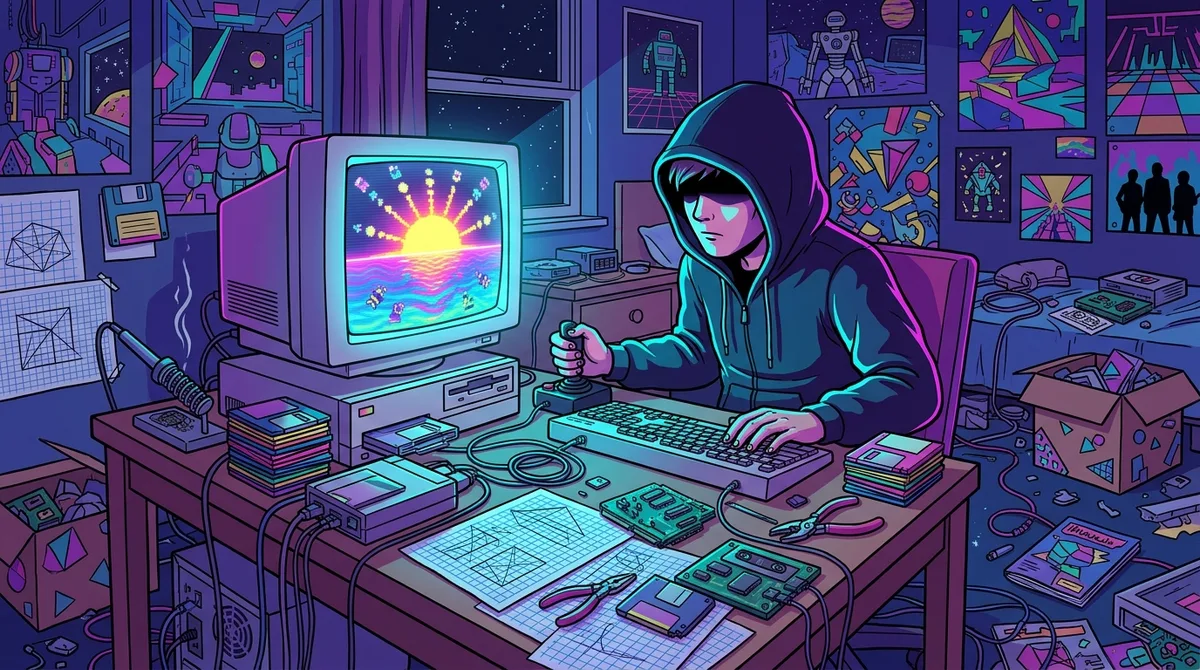
Picture yourself waiting for a game to load, then realizing the loading screen is more fun than the game. That’s basically what happened. Coders who once spent their nights stripping copy protection started spending them on scrolling text, color-cycling logos, and tiny sound loops. The crack was still there in the background, but it slowly became an excuse instead of the point.
Historian Markku Reunanen argues that the split was gradual, not a clean break. Some groups kept doing legal and illegal work side by side for a time, so one crew might crack a release while quietly polishing a piece for the next party. If you’re hunting for the exact moment crackers officially became artists, you’ll be chasing a ghost. The change was more like a slow fade on an old CRT than a light switch.
That finished piece is what people now call a demo. A demo is a standalone presentation that combines programming, graphics, and sound into one real-time show. Real-time is the magic word here. Nothing is a pre-recorded video. The machine calculates every wobbling sprite and every beat as it plays, so you’re basically watching a computer think out loud, in glorious neon.
Once a demo could stand alone, it became a showcase. The coder was judged on how tight the code was, the artist on how clean the pixels looked, and the musician on how well the tune hit. A crowd could tell within seconds whether a scroller was lazy or whether a palette had been chosen with real care. Nobody was just “the guy who cracked the game” anymore. Each part got its own applause, and each part had to earn it.
That shift is also why the scene feels so distinct from ordinary graphics tutorials. A tutorial teaches you a technique. A demo asks you to be impressed by the whole package, the way you’d react to a great synthwave album with a killer cover, a banger opener, and a track that sticks in your head for days. The old crack screens were the first rough drafts of that idea, and the people who made them kept raising the bar until the bar was art.
Early demosceners were writing to each other, and they did it with pen, paper, and postage stamps. A preserved correspondence collection holds 291 letters, exchanged by 82 groups across 14 countries between 1990 and 1991. Picture a mailbox acting as a neon dial-up modem, with a stamp standing in for a handshake.
Imagine tearing open an envelope from a crew on the other side of Europe, the handwriting full of loops and bravado, a floppy disk tucked in the fold. Snail mail was the group chat before group chats existed. Each letter could take weeks to cross a border, so every reply felt like a small event, and nobody wasted a line.
The letters were a practical toolbox. A neat trick for scrolling text or a clever way to squeeze more sound out of a chip could travel from one country to another in a single envelope. Coders learned by reading what others had figured out, then tried to top it in their next piece. Finished work moved the same way, so a demo made in one bedroom could end up on a screen in a crew’s living room far away, weeks after it was finished.
Rivalries were part of the mail too. A challenge, a sly dig at someone’s code, or a boast about a fresh release could be written down and posted back with a cheeky grin. Groups that had never shaken hands could still trade insults with great politeness, which was half the fun. Nobody wanted to lose a rivalry to a slow postal service.
Think about what that meant for the people involved. They had to write clearly, because a confusing sentence could cost a week. They had to be patient, because a reply might not arrive until the next season. They also had to be generous, because the whole system ran on crews sharing what they knew with people they might never meet.
That is why the scene deserves the title of a digital community across borders long before social media existed. The modem screeches and glowing chat windows came later. In 1990, the network ran on ink, paper, and a lot of stamps, and it still managed to connect coders, artists, and musicians from one end of a continent to the other.
Demoparties became the scene’s heart once people could meet face to face to show their work, compete, and swap tricks, and the first Assembly shows how that worked. Letters could carry ideas across borders, but nothing beat a room full of people watching a demo run on a real screen.
The first Assembly took place in Kauniainen, Finland, in 1992. The Finnish broadcaster Yle later reported that about 700 people came to the event. That’s a lot of people for a hobby that had recently run on photocopied flyers.
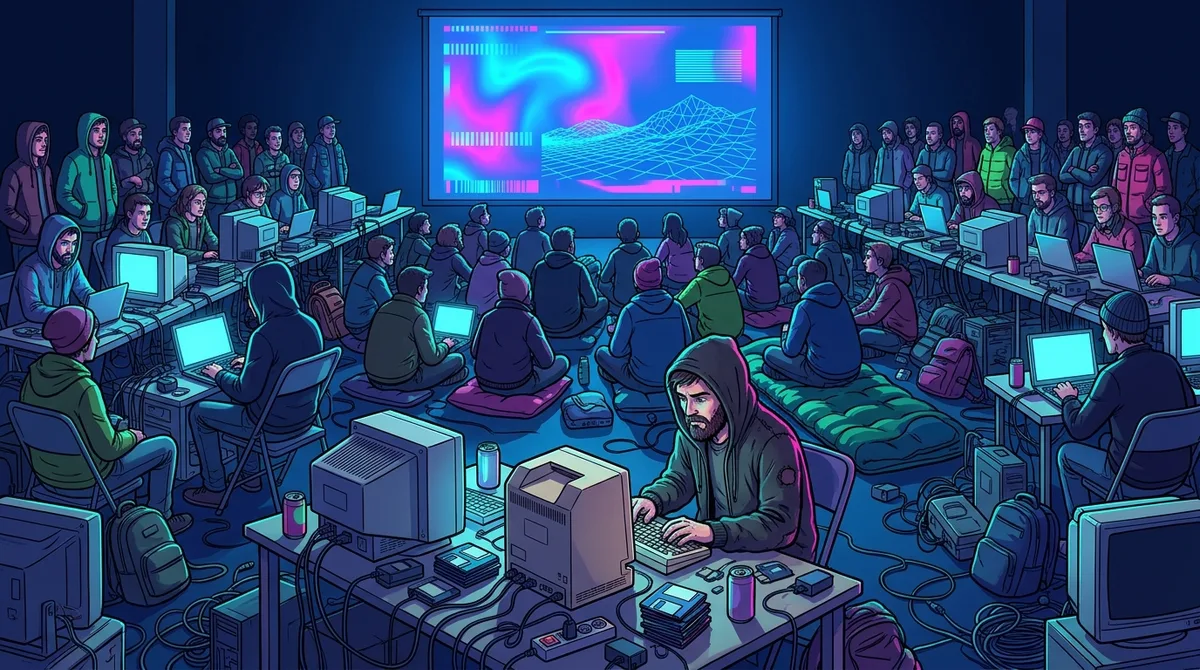
Picture the scene: tables crowded with beige computers, tangled power cords taped to the floor, and CRT monitors glowing in every corner. Somebody’s energy drink sits next to a stack of floppy disks, and a crowd gathers around a machine where a new demo is looping. Everyone is part fan club, part trade show, and part rowdy sleepover.
The competitions were the main event. Coders entered screen-filling pieces, where every pixel had to earn its place, and the audience could tell in seconds whether an animation looked sharp or sloppy. A wall of scrolling text that moved smoothly got cheers, while a flickery sprite got groans and friendly heckling.
The rivalries were loud and proud. A crew that had spent months on a demo might watch a rival group take the top prize, then grumble through a whole night of coding just to win next time. Those grudges often turned into friendships by breakfast, because the same people who trash-talked each other were also the ones who needed help with a stubborn bug.
The all-night coding sessions were where the real learning happened. Someone would show a clever trick for color cycling on a shared machine, and by morning half the room had copied it into their own work. Nobody guarded their secrets too hard, since a good trick made the whole scene look better, and that generosity kept people coming back to the next party.
Governments are protecting the demoscene because they now see it as living heritage, a creative skill passed from one coder to the next, much like a folk song or a traditional craft. Finland took the early step, and other countries have since followed its lead.
In April 2020, Finland added the demoscene to its Finnish Heritage Agency National Inventory of Living Heritage. The list then held 64 elements, and the demoscene landed alongside traditions like saw playing and Romani horse skills. Not bad for a hobby that once ran on photocopied flyers and midnight phone calls.
That move had a bigger backdrop. Finland had ratified UNESCO’s 2003 Convention for the Safeguarding of the Intangible Cultural Heritage back in 2013. That treaty is the UN’s rulebook for protecting traditions that live in people’s hands and heads rather than in museum cases, which makes a scene built on clever code and pixel-perfect loops a surprisingly good fit.
Recognition is nice, but saving things takes actual work. A preservation project ran through the end of 2024 and covered three jobs: digitizing old material, interviewing veterans who remember the early days, and filming a documentary at Finnish demo events in summer and autumn 2024. It was a rescue mission for code that might otherwise vanish on a dying floppy disk.
France followed in 2025, when it included the demoscene in its National Inventory of Intangible Cultural Heritage. The French Ministry of Culture lists it as a free culture sitting where art and technology meet, which is a very French way of saying “cool and nerdy at the same time.”
By the spring of 2026, a growing list of countries had joined the club. The Demoscene – The Art of Coding campaign counted these as the national recognitions so far:
Norway’s turn came on April 25, 2026, making it the eighth country to recognize the demoscene as national intangible cultural heritage. Each addition shows the same pattern: a subculture that started with rebellious screens before games loaded is now being treated like a tradition worth passing down.
For the old crack intros and copy-party tapes, that recognition is a big deal. Heritage status means someone has a reason to keep the files, record the stories, and show the work to new audiences who have never seen a scroller crawl across a beige CRT. The scene that once lived in mailboxes and bedrooms now has official paperwork, which is either very grown-up or the funniest plot twist in computer history.
The 64k and 4k limits are famous because they cap an entire program at a size so small that every byte has to earn its keep. At Evoke’s 2019 PC intro competitions, a 64k intro could be no bigger than 65,536 bytes, and a 4k intro had to fit into 4,096 bytes. Each entry also had a maximum running time of 10 minutes, so the piece had to keep moving for a full ten minutes without growing a single extra kilobyte.
Think of it as packing for a festival with only a lunchbox. You can’t bring a suitcase of pictures and albums, so you bring the recipe for making them instead. That’s the core trick of the whole challenge.
Graphics are the first place the squeeze shows up. Instead of storing a bitmap of a glowing neon grid, a coder writes a few lines of math that draw it on the fly. A spinning tunnel, a rippling plasma, or a chrome logo can all come from formulas that take up almost no space at all.
Sound follows the same logic. Nobody has room for a recorded track, so the music is built inside the program using tiny synthesizers. A handful of notes, a looping pattern, and a bassline that wobbles just right can sound like a full band, and it’s oddly satisfying to realize the whole soundtrack is smaller than a single text message.
Code gets squeezed too. Coders use special tools that compress the program itself, and the competition is fierce. Shaving a few bytes off a routine can be the difference between a piece that fits and one that gets bumped. Some entries are famous for their clever packing tricks, and crowds cheer for those as loudly as for the visuals.
The rules also turn the whole thing into a sport. Every decision matters, from which color palette to pick to how a sound envelope rises and falls. You can watch a 4k piece and feel the sweat behind it, the late-night arguments about one more byte, and the proud grin when the file finally squeezes under the limit.
Start with a 4k or 64k entry, because it’s the quickest way to see how much fits in a tiny file. Pick a short piece, put on some headphones, and try to guess how a few kilobytes could produce a spinning neon tunnel and a full soundtrack. You’ll probably end up staring at the screen like it’s doing a magic trick.
Next, track down a demo written for the Commodore 64. That’s the machine tied to the scene’s early days, when the C64’s sound chip and graphics gave coders plenty of room to show off. Old-school hardware has a special charm. Watch how the sprites zip across the screen and how the music sounds coming out of a chip that was never meant to sound like a band.
As you watch, pay attention to the three things that make every demo tick: code, pixel art, and music. Ask yourself which part grabbed you first. Was it a scroller that moved smoothly, a color palette picked with real care, or a beat that hit exactly when the screen flashed? Most demos are a balancing act, and noticing which element is carrying the show is half the fun.
Don’t worry if you don’t understand how any of it works. The crowds at the old parties didn’t understand every trick either. They just knew when something made their jaws drop, and that’s a perfectly good way to start your own tour of the scene.
Start with a 4k entry and give it a fair shot. Put on headphones, dim the lights, and watch it all the way through. Many of these pieces save their best trick for the final minute, so don’t bail early.
Then hunt down a Commodore 64 demo. The C64 was the machine behind the scene’s early crack screens and copy parties, so its sprites and tunes tell the origin story in one glowing window. Notice how the music sounds like a full band squeezed through a tiny speaker.
Next, pick a second demo from a different decade and compare the two. Ask yourself which one felt like a neon highway and which one felt like a cheeky mixtape. Jot down your answers in a notepad. Those notes will become your own private guide to the scene.
Finally, if one demo really hooks you, look up the group name printed on its title screen. Every piece has a crew behind it, and crews love an audience. Send them a message saying what you liked, and you’ll be part of the scene’s long tradition of trading praise by mail and by chat.