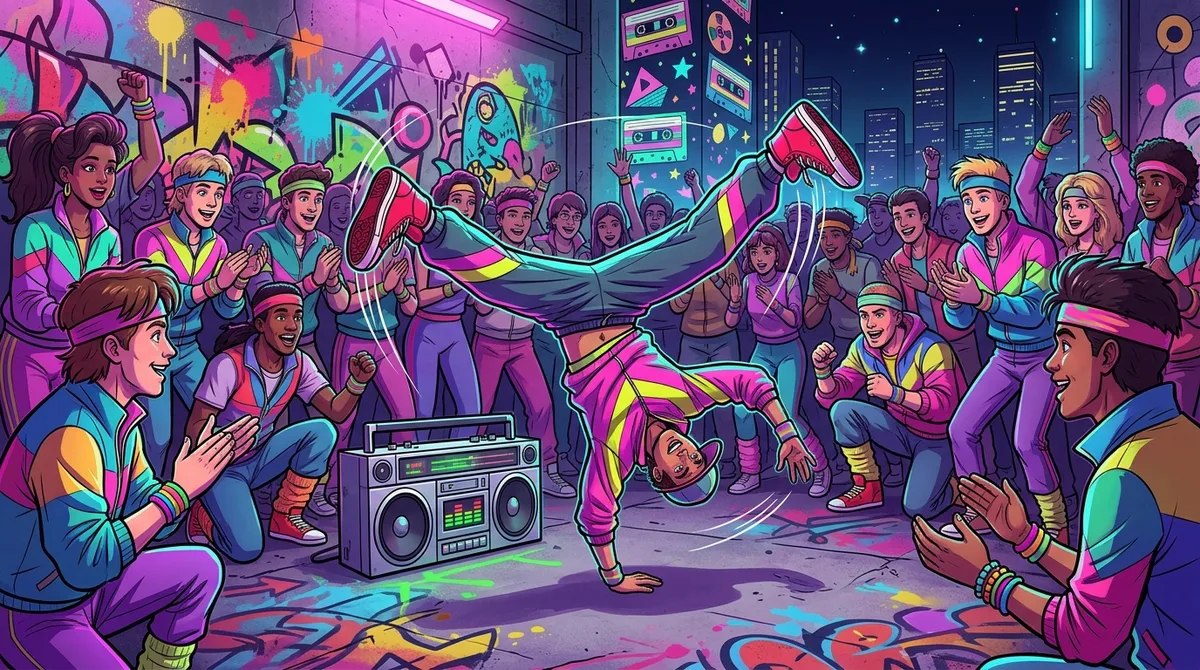
1980s breakdance culture turned a Bronx street dance into a worldwide sensation, even though the moves were already being thrown down in the 1970s. Think of it as the moment sweaty block parties hit the big screen. In 1984, Breakin’ arrived with a running time of 86 minutes, and its sequel, Breakin’ 2: Electric Boogaloo, followed with 94 minutes of footwork, flashy headspins and neon-soaked hype.
So grab your bucket hat, crank up the boombox and get ready for a ride through the glow. Breaking mixed movement, music and street style into one wild package, and it’s still going strong today, with the dance landing at the Paris 2024 Olympics. Ever wonder how a few kids with cardboard and cassette tapes ended up as Olympic material? Let’s find out.
Breakdance came out of the Bronx in the 1970s, long before neon jackets and movie posters made it famous. The 1980s were when the rest of the world noticed, not when the moves were invented.
Picture the South Bronx in the early 1970s: concrete playgrounds, a crackling boombox and a DJ dropping records. The Smithsonian’s 1993 folklife article dates hip-hop culture’s emergence to around 1973. It describes b-boys dancing to a record’s “break,” the hard-driving instrumental section where the vocals step aside and the drums take over. Those dancers worked the same beat again and again, stretching it out for as long as the crowd could hold on.
A 2021 York University doctoral thesis places the dance’s first growth in 1970s Bronx dance spaces. It argues the practice was almost exclusively African American teenagers at that stage. Later stories often put Latino youth front and center and leaned on 1980s media narratives, so the full picture is messier than the movie-poster version.
Then the cameras showed up. Films, TV shows and records carried the dance far beyond its home turf. The National Museum of African American History and Culture catalogs the 1984 program Graffiti Rock and the Hip Hop World, a 29-minute dance-and-music show featuring the New York City Breakers. It was a neon-lit snapshot of a scene that had been building on street corners for years.
Music helped too. The National Endowment for the Arts notes that Afrika Bambaataa and the Soul Sonic Force released “Planet Rock” in 1982, helping bring hip-hop music to a national audience. Suddenly the dancers had a soundtrack that radio could not ignore.
So the 80s didn’t give breaking its birth certificate. They handed it a bigger stage, a louder amplifier and a whole lot of glitter. The Bronx did the hard work first, and the decade just brought the boombox.
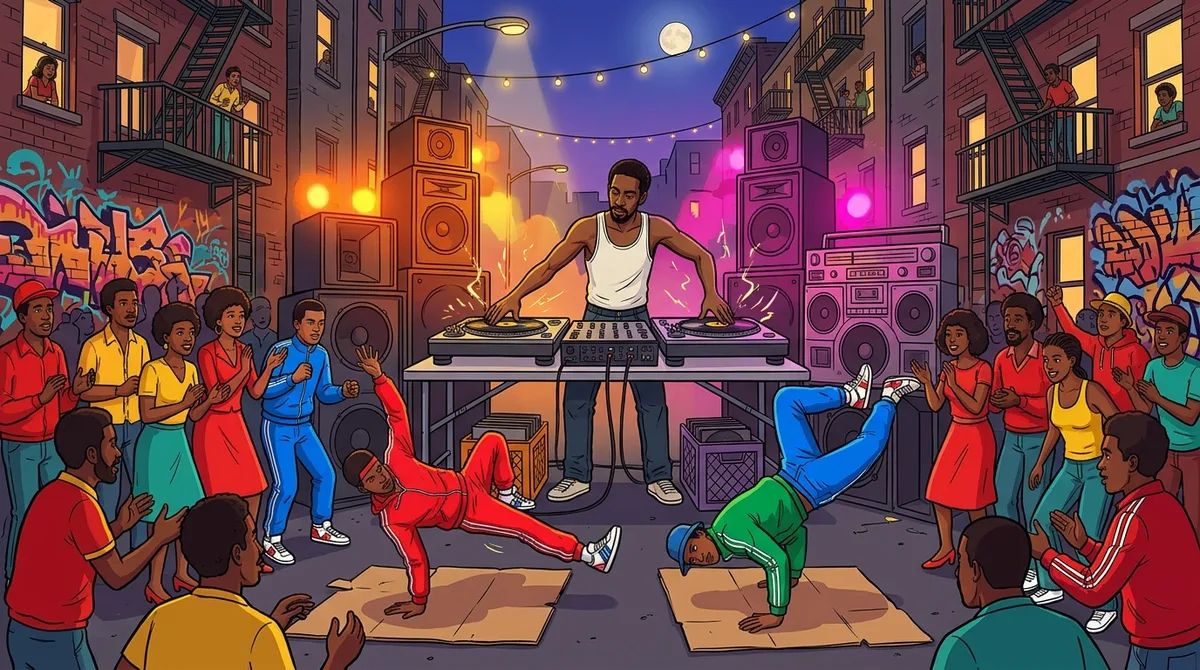
DJ Kool Herc gave breakers their stage by refusing to let the good part end. He noticed the crowd went wildest during a record’s break, so he played two copies of the same record side by side and switched between them, looping that drum-heavy section again and again. Suddenly the party had no end in sight, and the dancers had all the time they needed. Think of it as the ultimate extra life.
Picture the break as the moment the singer finally shuts up and the drums take the spotlight. For a b-boy, that stretch was pure gold. It was the part of the song built for footwork, spins and freezes, and it kept coming back as long as the DJ kept the records spinning.
The music and the dance were basically a two-person act. The DJ watched the floor and picked records that made people move, while the dancers read the beat and pushed it harder. Nobody called it a show. It was a block party, and everyone had a job.
That same drum-driven feel carried outside the Bronx. Afrika Bambaataa’s “Planet Rock” took a robotic, drum-machine groove and turned it into a hit, and suddenly the sound that had been ruling the park jams was blasting out of car stereos and radios across the country. Ask anyone who lived through it, and they’ll tell you the break was the heartbeat of the whole scene.
A b-boy is a male breaker, and a b-girl is a female breaker. Those are the words dancers use for the people who perform the dance, and you’ll hear them shouted from the crowd the moment a battle heats up. The names grew out of the “break,” the same drum-heavy section DJs looped at block parties.
Once you know the names, the moves are next. Three core moves show up in almost every battle. The continuous backspin is a roll over the back that keeps the body spinning in a steady loop. The windmill has the dancer rotating on the shoulders while the legs sweep through the air in wide circles. The whirl is a fast, flat spin where the body whips around in a tight orbit.
A 1993 Smithsonian account credits Crazy Legs with inventing the continuous backspin and Pee-Wee Dance with inventing the whirl. Crazy Legs, whose full name is Richard Colón, was also an original member of Rock Steady Crew in 1979. The Smithsonian documents a customized denim jacket he wore during the 1980s, which is a great example of how the crew’s style spilled out of the dance floor and onto the streets.
Here’s where people get tangled up. Popping and locking are separate styles, and they’re rooted on the West Coast rather than in the Bronx. Popping relies on quick muscle hits that jolt the body, while locking uses sharp freezes and playful pauses. A 2022 scholarly article on the Chinese dance craze piliwu notes that it blended U.S. breaking with California popping and locking, which tells you these styles were distinct enough to be named on their own.
So when someone calls a locking move a windmill, give them a friendly nudge. Your battle-watching cheat sheet is simple: if the dancer is spinning on their back, it’s breaking.
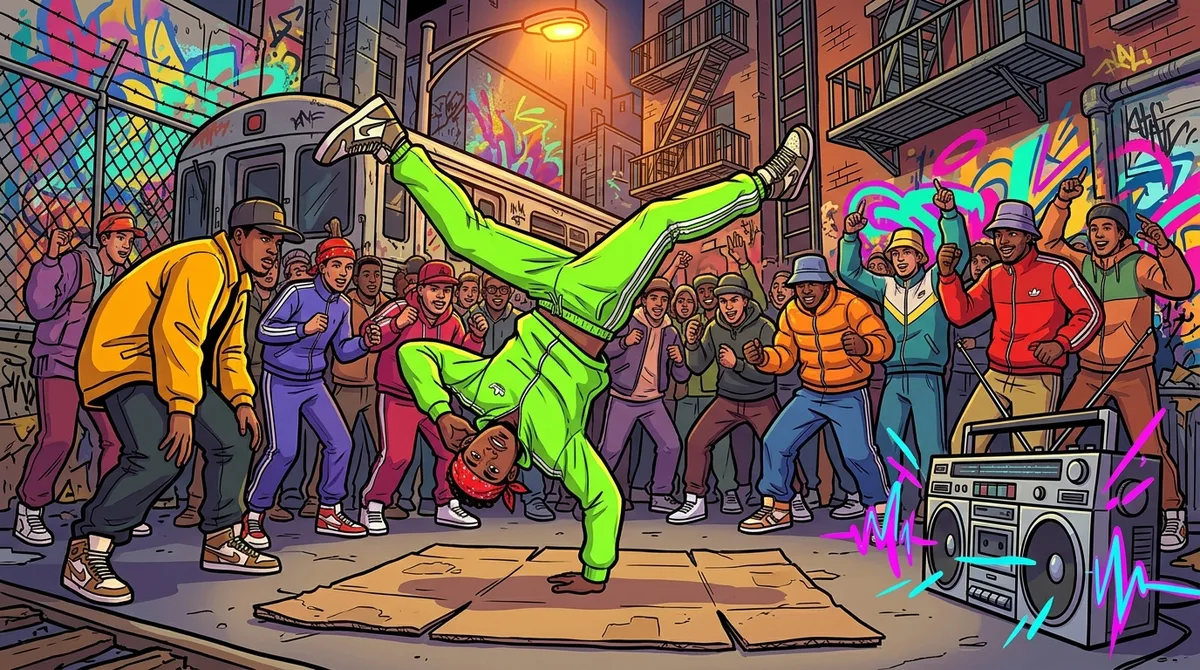
Breaking reached mainstream audiences through a handful of 1984 movies, a TV special, a couple of music videos and a Michael Jackson dance move that isn’t actually breaking. Grab your popcorn, because the neon is about to get very bright.
Start with the movies. Breakin’ ran 86 minutes, and its sequel, Breakin’ 2: Electric Boogaloo, stretched to 94 minutes of extra glitter. Beat Street, also from 1984 and also 86 minutes long, gave viewers a grittier, street-level look at the scene. Watch all three in a row and you’ll get a crash course in footwork, freezes and big hair.
TV had its own showcase. Graffiti Rock and the Hip Hop World, a 29-minute program, put the New York City Breakers in front of living room audiences, which was a big deal when your only other option was the rerun.
Then came the music videos. The video for “Buffalo Gals” put breakers in the spotlight, and the Rock Steady Crew used the “Hey You” single as a stage for their own moves. Watching them, you can see why the crew became one of the best-known names in the scene. Their routines looked like a block party had been lifted straight onto the screen.
Flashdance brought a street dance scene to a much bigger crowd. The footwork and floor work felt fresh to people who had never set foot in a Bronx park jam, so you could argue it was one of the first times breaking-style moves reached the general public.
Finally, there’s Michael Jackson. His moonwalk became one of the most famous dance moves of the decade, but it isn’t a breaking move. It’s a pop-world crossover moment, with a backward glide that looked like a magic trick. Breakers and fans often lump the two together, so keep them separate when you’re arguing about who invented what at your next watch party.
Breaking crossed oceans fast, and every local scene added its own spin. Think of it like a pizza: the base came from New York, but each city brought its own toppings. Dancers didn’t just copy the American videos. They studied what they saw, then mixed it with the styles already moving through their own neighborhoods.
China gives the clearest example. An 2022 Inter-Asia Cultural Studies article says the piliwu craze spread through urban communities in the latter half of the 1980s. Picture a Bronx-style windmill followed by a jolting California pop and a playful lock, all in one routine. That blend made piliwu sound and look like a brand-new power-up.
Why mix things up? Breaking was never just a set of rules. It was a way for young people in a particular neighborhood to show who they were. Local crews wanted moves that matched their own streets, so they borrowed what looked electric and kept what their crowd already loved.
Music and fashion traveled too, and they changed the dancing along the way. A breaker in one city might wear a jacket that looked nothing like the one in the next city, and the footwork picked up the same local flavor. So the dance stayed rooted in its New York beginnings while growing branches everywhere it landed.
Breakers in the 1980s mostly wore whatever looked loud, felt comfortable and could survive a windmill. Here’s the cheat sheet for the classic street look:
Looking back, the style was never about fashion rules. It was about looking ready for a battle before you even moved, then proving it with your feet. Pick up a sweatshirt that moves with you, tip your hat to the crowd and let the boombox do the talking.
Breaking reached the Olympics by surviving decades of cypher circles, picking up official rules and trading the free-for-all for a stopwatch. It joined the program at the Paris 2024 Olympics, a long way from the Bronx park where a DJ looped a record’s break for a crowd that wouldn’t quit.
Back in the 1980s, a battle had no clock. You threw down until the crowd got bored, the other crew took its turn, and the loudest hype usually decided the winner. Nobody was checking the time while Crazy Legs spun on his back.
Today the rules are far more structured. The World DanceSport Federation adopted Version 16 of its Breaking Rules and Regulations Manual on 27 August 2026, setting 60-second limits for solo routines, 90-second limits for team routines and a 10-second prompt timer. Your favorite freeze-and-flip combo now has to fit inside a tight window, like a pop song on the radio.
The next big stage is Dakar. Breaking is set for the Dakar 2026 Youth Olympic Games on 12 and 13 November 2026 at the Complex Tour de L’Œuf in Dakar, Senegal, with 12 B-Boys and 12 B-Girls allocated places. Those are kids who could be practicing on a cardboard mat in a living room, now competing under the official clock.
Ready to try it yourself? Start small, because nobody lands a windmill on day one. Clear a patch of carpet or lay down a thick blanket, then pick one move from the list above: the continuous backspin, the whirl or the windmill. Warm up your shoulders and wrists first, since they do most of the heavy lifting.
Set a kitchen timer for 60 seconds, the same solo limit the World DanceSport Federation uses today, and throw down a short routine. End with a freeze like the crowd is screaming for more. Then run it again and try to squeeze one extra freeze into the same window.
Once that feels comfortable, pick a song with a long instrumental break. Loop that section and practice your footwork while the vocals step aside. It’s the same trick DJ Kool Herc used, just with a phone instead of two turntables.
Want a style boost before you go? Check out the Smithsonian’s page on Crazy Legs’ customized denim jacket, then pull out your loudest sweatshirt. Skip the windmill until your neck and shoulders feel ready. Your living room is the new park jam, so pick a move, start the timer and have fun.