A custom retrowave soundtrack has no single price tag, but the numbers give you a useful starting point. One-minute custom game tracks can begin around $175, while a bundle of six shorter tracks can land near €3,300. Think of it like buying a neon sign: the price depends on how big it is, how many bulbs it needs, and whether it blinks on a schedule.
Most freelance composers price by the finished minute, and GameSoundCon’s 2025 survey found that 55% of freelancers working on indie games do exactly that. Rates swing wildly from one composer to the next, so treat every number here as a benchmark, not a menu. Ask for quotes in writing, spell out how many revisions you get, and confirm the file formats before your synth riff goes anywhere near your trailer.
Most custom retrowave soundtracks land somewhere in the hundreds of dollars, with bigger projects climbing into the thousands. The exact number depends on how long your tracks run, how many rounds of tweaks you want, and who you hire.
Freelancers who work on indie games and charge by the finished minute reported an average of $618 per minute. The median was $407, which means a few big quotes pulled the average upward. The most common rate was $400, and the highest reported was $2,100 per finished minute. If you’re a solo creator building a neon-soaked platformer, your budget will likely sit closer to the lower end.
Bigger productions cost more. Mid-core games averaged $998 per finished minute, with a median of $1,000. AAA projects averaged $1,871, with a median of $1,700. Think of it like booking a garage band versus a stadium headliner. Both play music, but the crew, the lights and the time involved make for a very different bill.
These numbers come with two catches. They cover game music in general, not retrowave specifically, and the survey was not randomly sampled. Treat them as a rough map of the game audio world, not a price list for synthwave.
Market listings for custom tracks of one to four minutes commonly fall between $175 and $500. Cheaper offers often include fewer revisions, while pricier ones usually give you more rounds of tweaks. That extra cash buys you more chances to get the bassline just right.
Before you compare prices, check what counts as a “finished minute.” Some composers bill loops, alternate versions or stems as extra minutes, and others don’t. A low per-minute rate can get expensive fast if every small variation is billed separately.
Custom retrowave prices vary because every quote covers a different amount of work, and the price follows that work. These are the main levers that push a number up or down.
Length comes first. Some composer listings charge $275 for two finished minutes and $500 for four, so doubling the runtime doesn’t always double the bill. Ask whether loops or alternate versions count as extra minutes, because a low per-minute rate can climb fast.
Revisions usually rise with price. In the same listings, the two-minute track included three rounds of changes and the four-minute track included four. More rounds mean more of the composer’s time, so cheaper offers often give you fewer chances to fix that squealing lead.
Deliverables add up too. A loop that repeats cleanly, a set of stems for your sound designer, or a shorter mix for a trailer each takes extra work.
Bundles follow their own math. Many composers price each track separately but require a minimum, sometimes four tracks, so a two-track order may not qualify for the bundle rate at all.
Experience shows up in the rate. A composer with a long list of released game scores will usually charge more per minute than someone newer to commissions. Rush jobs cost extra as well, since squeezing your track into a packed calendar means bumping other work. Standard turnarounds for bundles often run six to eight weeks, so a tight deadline is a bigger ask.
Your music agreement should spell out where the music can be used, how long you can use it, who gets credit, how many rounds of changes you get, what files you receive, and whether anyone can resell the tracks. Skip any of those and your synth riff could end up on a T-shirt you never approved.
Before any money changes hands, make sure the contract covers these points:
Promotional use is the sneaky one. A license for a game may cover its launch trailer, but a 15-second clip for a short-form video might not count unless the contract names social media. Ask for it by name.
“Perpetual” sounds generous, but it often comes with strings. A typical standard commercial license in the market grants perpetual use in one game or multimedia project and its related promotions, and it usually requires composer credit. Check whether your retro track can follow you into a sequel or a second product before you sign.
Revisions need rules too. Ask for changes in one consolidated list per round, sent through a single thread with a deadline. Vague notes like “make the bassline more sunset” can burn through your revision rounds faster than a boss rush.
Standalone soundtrack resale is the big one. If you want to sell the tracks as an album or bundle them into a sample pack, you need separate written permission. A yes for your game does not automatically mean yes for an album, so get that second yes in writing.
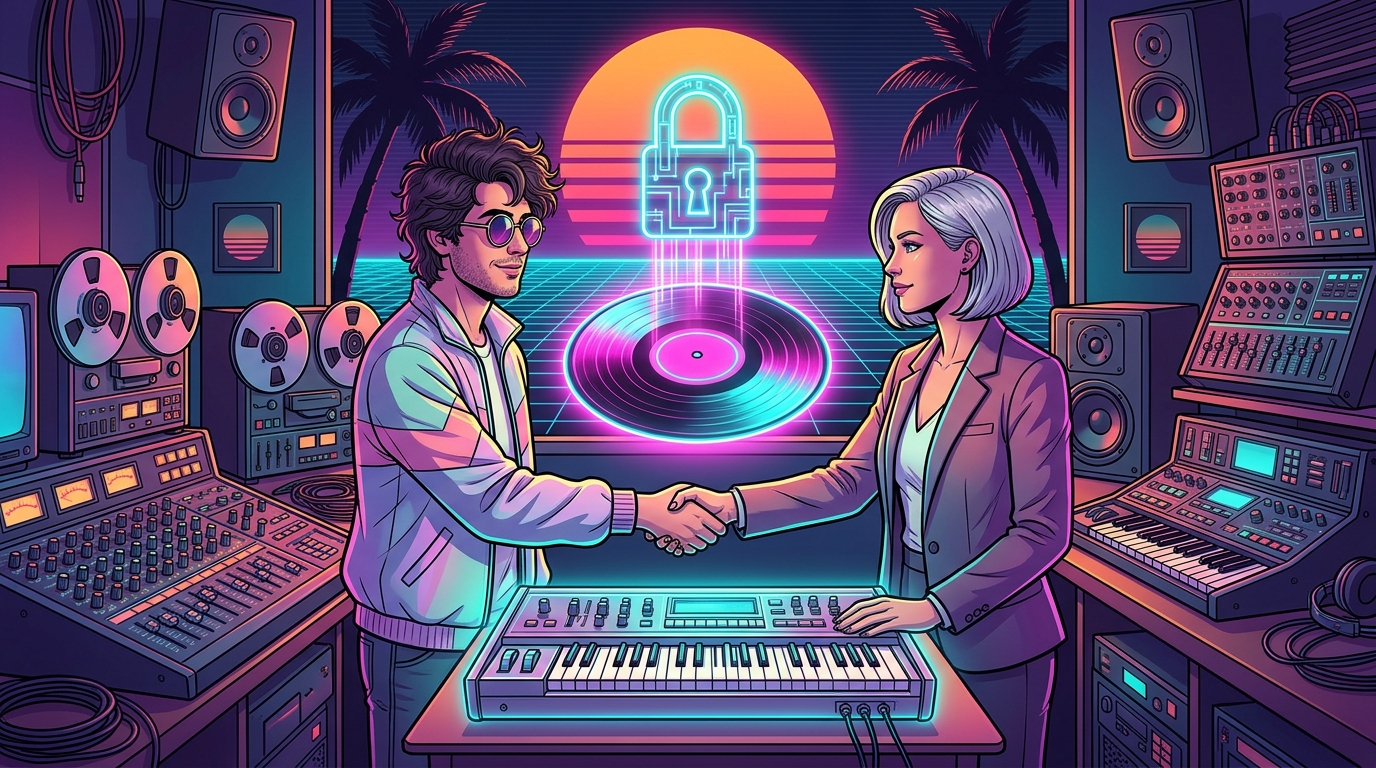
You own a commissioned retro track only if your signed agreement says so, because the composer usually keeps the copyright by default. Hiring someone to write your music doesn’t automatically hand you the keys, so the paperwork decides who ends up holding the neon sign.
A recorded song can hold two separate protected works. The musical composition covers the melody, chords and lyrics, while the sound recording covers the specific performance and mix captured in the file. The U.S. Copyright Office notes that these two are often owned and licensed separately, so you could end up with rights to one and not the other.
Protection starts earlier than you might expect. Copyright begins when an original work is fixed, which means the moment your synth riff is saved as an audio file or notated in a digital file. Nobody has to stamp a copyright symbol on it for the protection to exist.
Work made for hire is the tricky shortcut. Under 17 U.S.C. § 101, a commissioned track counts as work made for hire only if it falls into a specified category, such as part of an audiovisual work, which can cover music written for a game or video. Both parties must also expressly agree in a signed written instrument. Miss either condition and the work doesn’t qualify.
Here’s the practical move: ask the composer which category your track falls into, and get the ownership sentence in writing. If the answer is a shrug or a verbal handshake over a video call, assume you’re getting a license, not the master files.
A single custom track usually takes one to three weeks from brief to delivered file. A mini soundtrack of several tracks often runs about two months, and a bundle of six tracks is commonly estimated at six to eight weeks. Treat those ranges as a starting point for your own calendar, not a promise.
Single tracks are the sprint. The composer writes, records and mixes one piece at a time, so there’s less juggling. A full score is more of a marathon, and its timing is usually agreed project by project, since the number of cues, their lengths and how they link together change the schedule a lot.
Revision rounds add time. Each round means you send notes, the composer makes changes, and you listen again. If your feedback trickles in as scattered texts over three weeks, the clock keeps ticking the whole time.
Feedback delays are the sneaky stretch. Waiting on an art team’s sign-off for a trailer, or a producer who is out of the office for a week, can push delivery back as much as a slow composer can. Build those gaps into your plan before your neon-soaked deadline starts flickering.
What shrinks the timeline? A clear brief, quick replies, and a single consolidated list of notes per round all help. Agree on loops and stems up front, because adding them late means extra work. Ask for the schedule in writing, along with the number of revision rounds, so the deadline has some teeth.

Yes, generative AI is showing up in game music work, but so far only in small doses. In the 2025 industry survey, 8% of professional respondents said they were using generative AI in game-audio work, and another 15% said they were exploring it. That leaves most of the scene still building its synth lines the old-fashioned way.
The survey was not randomly sampled and may overrepresent more-connected professionals, so the figures reflect the people who responded. Think of it as a Polaroid of the scene, not a full neon mural.
Before you hire anyone, ask your composer how they make their music. Do they write and perform the parts themselves, or do they start from AI-generated sketches? A straight answer is fair to expect, and a composer who dodges the question is waving a big red flag, like a flashing “Game Over” screen.
Then read the contract closely. Look for a clause that says whether AI tools can be used, whether AI-generated material can appear in the delivered tracks, and who owns or licenses that material. If the agreement says nothing, add a line covering it before you sign, because a silent contract can leave you guessing about your own synth riff.
Before you email anyone, write a brief that a composer can actually price. Think of it as an order slip at a neon diner: the clearer you are, the fewer surprise bills you get.
Start with the basics. Note the project type, such as a retro platformer, a launch trailer or a branded video. Add the track length in seconds or minutes, your mood references like “neon-soaked chase scene” or “bright 80s pop chorus,” and the date you need final files.
Next, set a budget range. Per-finished-minute rates in the market can start around $150, and higher rates are common for larger projects, so multiply your track length by the rate to see a rough total. Pick a ceiling you can live with and share it, so nobody wastes time on a quote you can’t pay.
Then work through the process:
Open a blank doc tonight and title it after your game or brand, because a brief with a name gets read faster than one called “music stuff.” Then fill it in with your real details, for example: “Two-minute title theme for a neon platformer. Used in the game, its launch trailer and a 15-second social cut. Three revision rounds. WAV files, loop points and stems. Final files due on a date we can actually hit.”
Send that brief to your three to five shortlisted composers, and add one line asking which of their past tracks sound closest to your target. A composer who names specific tracks has clearly listened to their own catalog, which is a good sign.
When the quotes arrive, line them up in a simple table with columns for price, minutes counted, revision rounds, file types, credit wording and resale terms. Circle any row where one quote is missing something the others include. That gap is usually where the surprise invoice hides.
Finally, book a 20-minute call with your favorite composer. Ask them to read the ownership sentence and their answer on AI tools out loud. Once both answers are clear and in writing, you can pay the deposit and let that synth riff start humming.