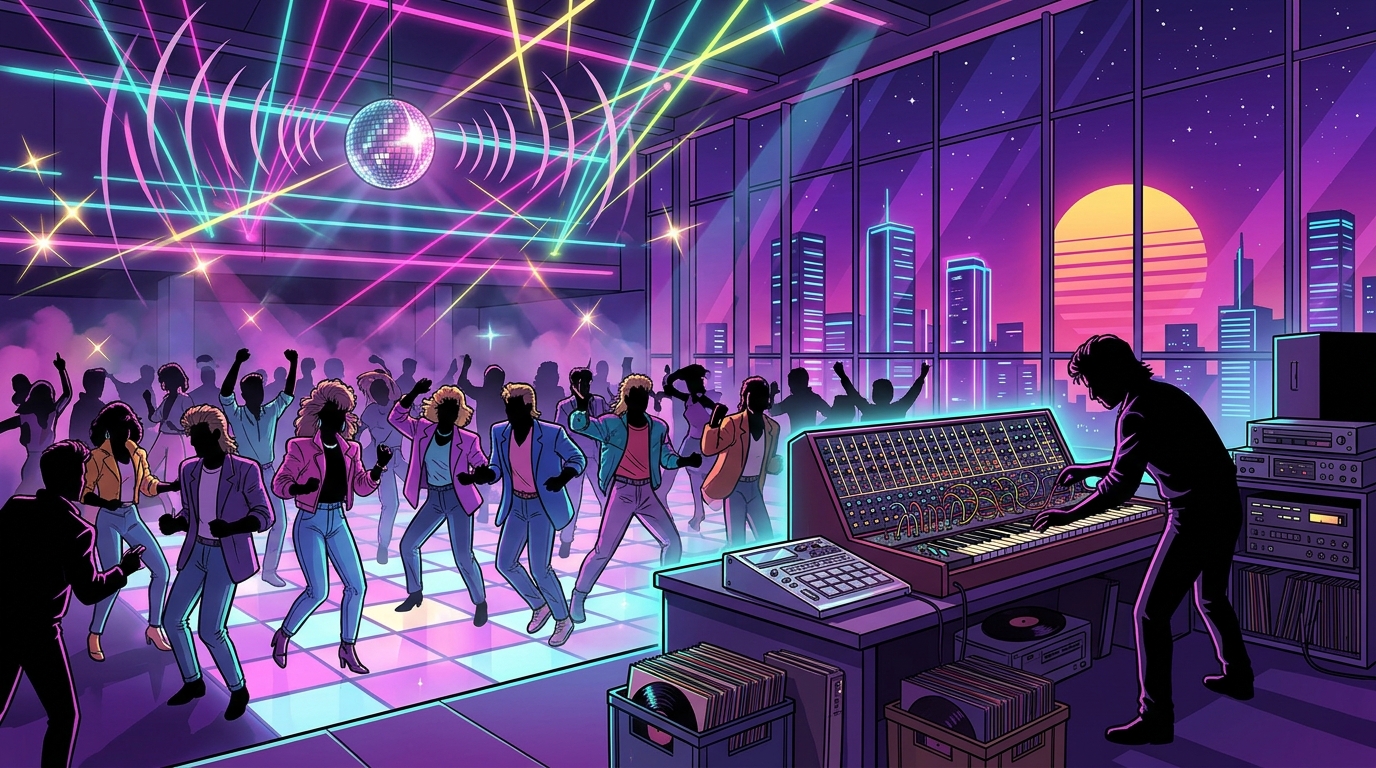
Italo disco history starts in Italy in the early 1980s, when producers took the sweaty energy of post-disco and drowned it in synthesizers, drum machines, and a generous helping of American and British electronic pop. Picture a dance floor glowing in neon, shoulder pads everywhere, and a keyboard doing its best impression of a spaceship. The big turning point came between 1983 and 1985. Cheaper instruments and the MIDI standard of 1983, which let electronic gear talk to other gear, made it far easier for anyone with a little cash and a lot of nerve to cut a record. The result was a flood of releases. The Italo Disco History Book estimates that Italian producers and labels put out roughly 4,000 to 5,000 releases between 1983 and 1987, although most were filed under plain old disco or dance music.
Then there is the name itself, which is a bit of a plot twist. German label ZYX Music began marketing Italian dance records overseas, and by 1982 it was already selling them as “original italodisco.” That came before its better-known 1983 compilations made the term stick, and the prefix had even turned up on German pop collections in the late 1970s. So the story is less a single lightning bolt and more a remix of several moments. Keep that in mind as you dig in, because the history gets juicier the deeper you go. Grab your leg warmers, crank the volume, and rewind the tape to the moment Italy started making the future sound like a dance floor.
Italo disco is a fully electronic form of post-disco that grew out of Italian dance music in the early 1980s, built on synthesizers and drum machines. If you have ever wondered what a roller rink would sound like after a software upgrade, this is your answer.
Picture rollerskating through a neon arcade at midnight. Every corner flashes, a synth melody bleeps like a power-up sound effect, and a bassline pulses like a heartbeat stuck on fast forward. Italian producers took the groove of disco, which had been full of strings, horns, and live drummers, and swapped most of those players for machines that never got tired.
The ingredients are simple once you break them down. Bright synth leads ride on top. Drum machines keep a steady beat that makes your feet move on their own. Basslines loop tightly and pump along underneath. The vocals often sound robotic, sometimes run through effects that make a singer seem to be broadcasting from a space station. Many tracks were sung in English, which only added to the futuristic glow.
These sounds did not appear out of thin air. Producers were listening closely to American and British electronic pop, then blending those influences into something glossy and ready for the dance floor. A 2025 scholarly article notes that Italian productions also inspired DJs and pioneering musicians in Chicago and Detroit, the cities that helped shape house and techno. A record cut in a small Italian studio could end up echoing in clubs thousands of miles away.
The business side was just as busy. A conference paper from the International Association for the Study of Popular Music explains that ZYX and the Spanish distributor Blanco y Negro carried Italian-made disco to audiences outside Italy through licensing deals during the 1980s. Bold fonts, shiny covers, and futuristic artwork were part of that package, so the look of the genre was baked in from the start.
That is why the sound still feels like a time machine. One synth stab and you are suddenly surrounded by shoulder pads, glittery jackets, and dance floors lit by sweeping lasers. Synthwave fans and retro gamers recognize the same bright, digital optimism, which explains why the music keeps popping up on their playlists today.
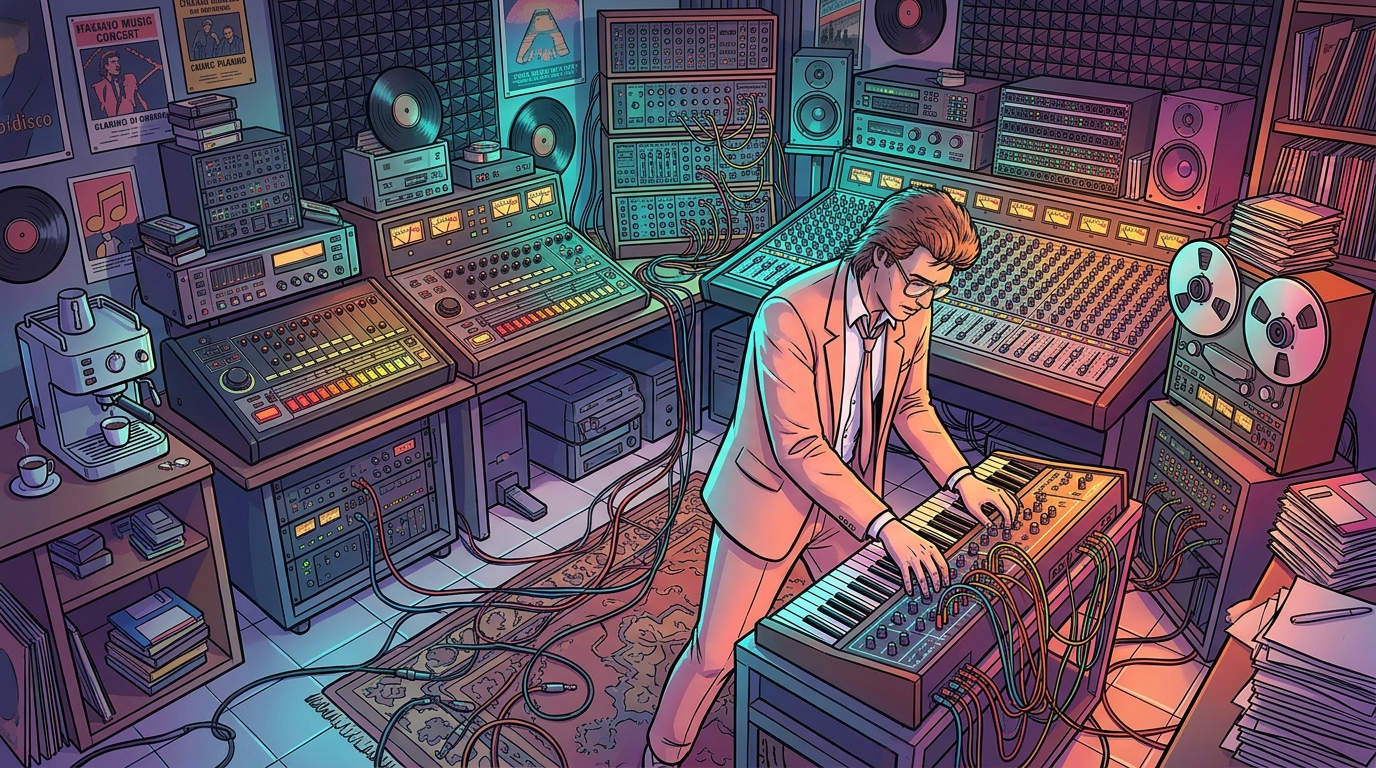
Italian producers built their sound from affordable electronic instruments and then wired those instruments together, so one person could do the work of a whole band. Between 1983 and 1985, a stretch often described as the experimental years, that combination changed who got to make dance records.
Before this shift, a glossy dance record needed a proper studio, a pile of expensive gear, and session players who expected to get paid. As cheaper synthesizers and drum machines reached the market, a producer with a spare room and a stubborn streak could start making tracks. The shiny keyboard in the corner did not need a recording budget the size of a small country.
The real game changer was MIDI, a standard that arrived in 1983. Think of MIDI as a group chat for gadgets. One keyboard can tell a drum machine when to hit, and a bass machine which notes to play, all through a single cable and a shared set of messages. Nobody had to be a wizard to get machines talking, which made it much easier to stack sounds on top of each other.
Layering was the secret sauce. A producer could record a bouncy synth riff, copy it, add a pulsing bassline, then drop in a handclap pattern and a robotic vocal hook. Each layer took minutes rather than days, and every tweak was easy to undo. That speed meant more ideas got finished, and more finished ideas meant more records hitting shop shelves.
The scale of the scene shows what this meant in practice. Small labels could compete with much bigger names if they had one track that caught fire. The history chapter reports that an ordinary il Discotto record sold around 2,000 pressed copies, but its Cocktail and Hulahoop mixes were pressed in runs of about 10,000. A tiny operation with a catchy mix could suddenly have a hit on its hands.
There was a flip side, of course. Cheap gear came with preset sounds, and plenty of producers reached for the same bright patches. Many tracks sounded similar, and that sameness is part of why the genre gets lumped together today. Still, the quirks mattered too. A slightly wobbly synth or a drum machine’s stiff beat became a signature, the audio equivalent of a neon sign with one letter flickering.
So picture a teenager in a bedroom, a keyboard blinking on the desk, and a drum machine clicking away like a retro video game. That DIY spirit, powered by cheap hardware and a shared digital language, is what gave Italo disco its restless energy.
The short answer is that the German record label ZYX did the most to turn “italodisco” into a name people used outside Italy, though it was a gradual push rather than a single lightning bolt. Think of it as a rebrand that took a few years to stick.
To understand ZYX, start with its founder. Bernhard Mikulski began his own pop-import company in 1971, so the business was built on bringing foreign music to German shoppers long before anyone was talking about Italian dance floors. The company was renamed ZYX Music in 1992, so the label many collectors know today wears a name it did not carry during the boom years.
That import habit explains a lot. A company used to hunting for records from abroad would spot a stack of Italian dance singles and see a market, not just a pile of vinyl. The Spanish distributor Blanco y Negro ran its own licensing deals, so the same music traveled along more than one route.
Then came the compilations that made the tag stick. The Italo Boot Mix and The Best of Italo Disco, both 1983 releases, gave buyers a neat package with a clear name on the front. If you were flipping through a record bin in Germany, a title promising the best of Italian disco was hard to walk past.
Packaging was doing real work here. The name and look of the records were shaped by what overseas buyers expected, so covers were designed to catch a foreign eye. The sleeve became a sales pitch, and the sales pitch slowly became the genre’s identity.
Here is where the tidy story starts to wobble. Recent scholarship, including Guglielmo Bottin’s 2025 study and his chapter “The Origins of Italo Disco” in the Oxford Handbook of Pop Music, complicates the neat 1983 version. The picture is messier than a single label launch.
Here’s a twist that should make any dance-floor historian grin. A 2025 article in Dancecult notes that the word “italodisco” was barely used inside Italy until the mid-2000s. Picture asking a club regular in Milan in 1984 about italodisco and getting a blank stare, possibly with a drink in hand.
The Italian identity was often a label applied later. Plenty of these songs were sung in English and aimed at international ears, so the country tag was partly a retrospective description by people looking back. That explains why a genre so tied to Italy can feel so global, like a party with a passport stamp on the door.
So next time you find an old 1980s sleeve, flip it over and check the credits and the label. Is the word italodisco printed as a promise to the buyer, or is it just a mood? A little detective work on the packaging can tell you who was shipping the music and what they wanted you to hear.
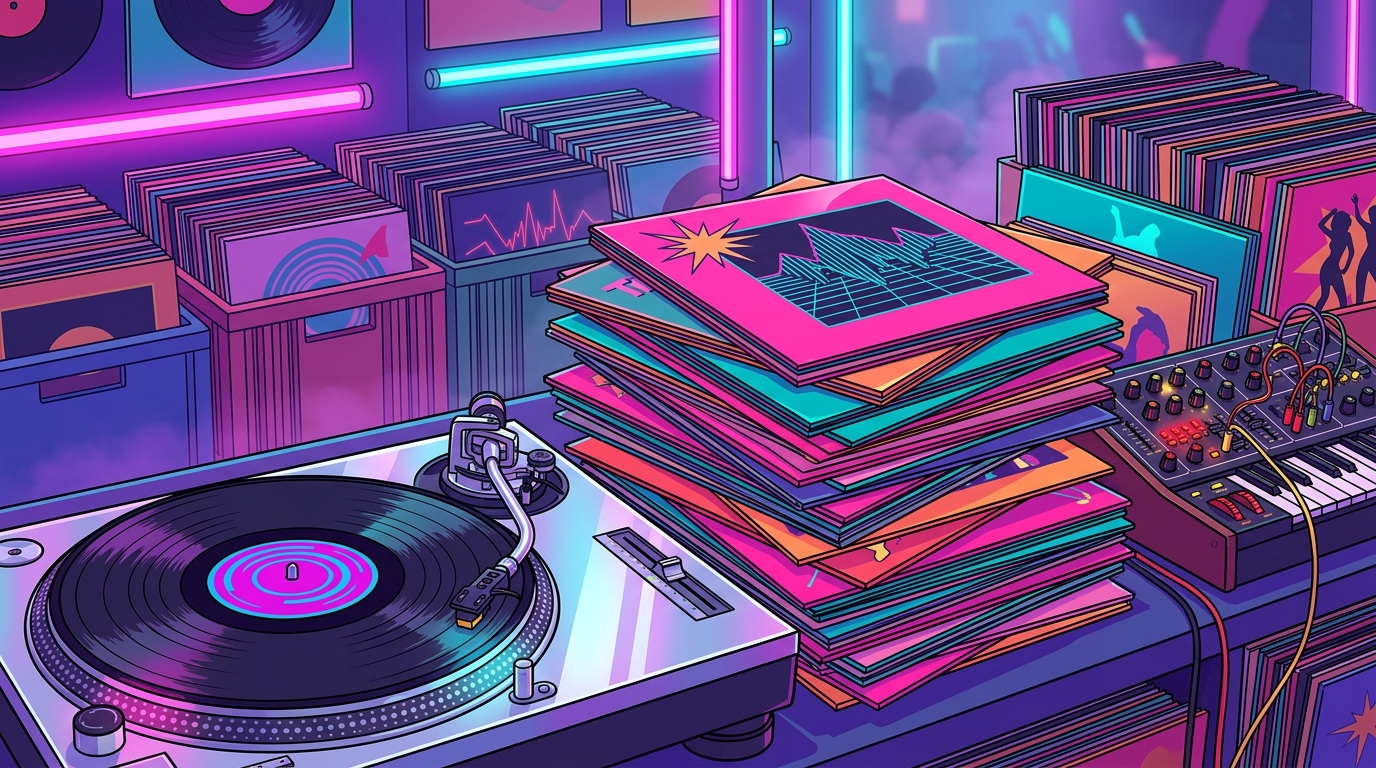
Four independent labels did much of the heavy lifting between 1983 and 1985: Memory Records, Discomagic, Baby Records, and il Discotto. If you want to start a crate-digging trip, those names are the best map you can carry.
Picture a record shop with no alphabetical order, where every sleeve is shouting for your attention. Chrome lettering, airbrushed skylines, and models posing beside synthesizers that look like they were beamed down from a mothership all compete for space. Flipping past that wall of cheesy album covers is half the fun, and the other half is wondering which one is secretly a banger.
Independent labels were built for speed. A small company could sign a producer, press a batch of copies, and be ready with the next release before the latest trend had cooled. That quick turnaround is a big reason the scene grew so fast, because nobody had to wait for a major corporation to decide whether a dance record was worth the risk.
The labels that stand out most from that period are these:
Each one put out a steady stream of tracks, and together they helped the genre look like a full-blown movement rather than a few lucky hits. Stack their catalogs on top of the wider flood of releases from other Italian producers, and you get a record bin tall enough to swallow a whole weekend.
The sales math is where things get especially fun. An ordinary il Discotto record was pressed in a modest run, but its Cocktail and Hulahoop mixes went out in runs five times larger. Those extended mixes were built for club DJs who wanted something longer and more hypnotic, which tells you that the dance floor was the real customer. A small label that understood its crowd could punch far above its weight.
If you love house and techno, this is where the family tree gets interesting. Italian productions influenced DJs and pioneering musicians in Chicago and Detroit during the 1980s, and those cities went on to shape house and techno. Imagine a Chicago DJ at two in the morning, sorting through imports with a stack of glossy sleeves on the turntable, pulling out a rubbery bassline and a robotic vocal hook that would later echo through the clubs. The synth-heavy pulse you hear in those scenes has a little Italian neon buried in its wiring.
So when you flip through a bin of 1980s imports, look for the label names and the mix credits, not just the covers. The wildest sleeves often hide the most important sounds, and the labels that printed them were the ones doing the real building.
Not really, at least not in the simple way the name suggests. The Italian tag was largely a label attached later, and many of the songs were sung in English because they were made for buyers abroad.
Picture a sitcom cast. There is a producer in a cramped Italian studio, a German record executive with a catalog to fill, and an overseas shopper who just wants something that sounds like a spaceship landed in the club. Every episode ends with someone asking, “But where is this music actually from?” It is a fair question, and the answer keeps changing depending on who you ask.
English lyrics were a practical choice, not an accident. An English chorus travels easily. It works on a dance floor in London, Madrid, or Frankfurt without translation, and it makes a record feel like it belongs anywhere. The production was Italian, but the words were often written for a crowd that did not speak Italian at all.
Then there is the mid-2000s clue. Inside Italy, the word italodisco was hardly used until that later period, which means the people dancing to these records in the 1980s probably never called them by that name. Instead, the Italian identity grew as a retrospective description, a way of looking back at internationally minded music and filing it under one country. It is a bit like a character who gets a nickname years after the show ends, and then everybody suddenly uses it.
Why should this matter to you as a fan? Because the genre’s identity was shaped as much by export marketing as by where the records were pressed. Titles, English hooks, and glossy packaging were all built to sell beyond Italy, and those choices still color how the sound is remembered. Once you know that, a track stops being a postcard from Milan and becomes a product of a global music market.
So the identity crisis is not really a flaw in the story. It is the plot. Italo disco is a show where the main character keeps getting a new name, a new audience, and a new soundtrack, all while the synths keep humming in the background. The only thing that stays constant is the glow of neon, and even that was partly designed to catch the eye of a buyer far from home.

Italo disco is back in the spotlight because researchers, filmmakers, and streaming services have started paying attention to it at the same time. For decades the genre was the cool kid that played every retro party but rarely got a proper credit, and now it is finally getting its premiere.
The academic side arrived first. Guglielmo Bottin’s chapter “The Origins of Italo Disco” was published in the Oxford Handbook of Pop Music in 2026, on pages 305 to 322. A chapter in a handbook like that is the music-history equivalent of a velvet rope and a name tag, and it means the scene is being studied as a serious subject rather than a guilty pleasure.
Film gave the revival its big screen moment. Sergio De Angelis’s documentary Italo Disco began its Italian theatrical run on October 18, 2025. Sky TG24 reported that in April 2026 the film returned to selected cinemas and became available on CGTV.IT and Prime Video Channel, so you could catch it in a theater or on your couch in your pajamas.
That timing is no accident. The genre fits neatly into the wider retro revival, where people are hungry for the look and sound of the 1980s. Synthwave artists have been chasing the same glowing synth leads and punchy drum machines for years, and the overlap makes the two sounds feel like cousins at a family reunion.
Retro gaming plays its part too. Bright, digital, slightly cheesy sounds are the language of old arcade cabinets and home consoles, so a synth stab from 1984 slides right into the mood of a pixel-art world. The neon palette does the rest, turning album covers and club flyers into the kind of imagery that looks perfect on a phone screen.
Then there are the 80s-style memes. A shoulder-padded dancer, a chrome keyboard, or a glittery jacket can turn up in a meme, and suddenly a whole generation that never owned a cassette player is humming a hook they have never heard before. Each share keeps the neon aesthetic glowing a little brighter.
The fun part is that the story is still being rewritten. Scholars keep debating who named the genre and how Italian it really was, and every new documentary or paper adds another layer. You get to watch a cult favorite finally step into the light and realize the party was never really over.
Start with the two compilations that defined the export image: Italo Boot Mix and The Best of Italo Disco. Put them on, and you get the whole neon recipe in one sitting, from bouncy synth leads to robotic vocal hooks.
Once those are spinning, go hunting through the labels. Memory Records, Discomagic, Baby Records, and il Discotto released plenty of deeper cuts, so search their names on record sleeves and see where the rabbit hole leads. Don’t skip the extended mixes either, since that’s where the club-floor magic lived.
Judge the records the way the era did. Look for neon covers, bold fonts, and sci-fi imagery, because a sleeve covered in lasers and chrome robots is basically a movie trailer for the sound inside. If the cover looks like a spaceship crash-landed in a shopping mall, you’re on the right track.
Share your favorite tracks and your best retro finds with fellow fans, whether that’s a scratched 12-inch from a flea market or a cassette hiding in a parent’s attic. Just don’t blame us when your playlist starts glowing.
Start with one record from the 1983 to 1985 window and treat it like a case study. Pick a label such as Memory Records or Baby Records, then find a release you can actually play. Listen to the standard version first, then the extended mix if there is one, since those longer cuts were built for club DJs and stretch the groove out for minutes.
Grab a notepad or your phone and jot down what you hear. Count the layers: a bouncy synth riff, a pulsing bassline, a handclap pattern, and a robotic vocal hook. If you can pick out each one, you are hearing the cheap-gear recipe that let a single producer work like a whole band.
Then widen the net. Build a ten-track playlist that pulls from at least three different labels. Include one track with English lyrics and one that feels more Italian in its phrasing and mood. Notice how much the words change the vibe, because that is the identity question playing out in your own ears.
Finally, head to a flea market or record fair and flip through the sleeves. Look for label names, release years, and any mix credits printed on the back, especially Cocktail or Hulahoop versions. Those small clues show which records were made to fill the dance floor and which were made to fill the bin, and you get to decide which pile you want to take home.