Spacesynth music history is the tale of synthesizers ditching the neon boulevard and blasting off into deep space. It starts in the 1970s with European space music, all long, drifting synth journeys, and lands in the 1980s with spacesynth, a faster, dance-ready offshoot of Italo disco. Jean-Michel Jarre’s Oxygène arrived in France in December 1976 with six connected parts running 39 minutes and 45 seconds. Think of it as the original long-haul starship ride.
Spacesynth hit its stride in the 1980s, when Italian acts like Koto and Dutch project Laserdance started mixing futuristic imagery, sticky synth riffs, and dance rhythms. Laserdance’s first track under that name came out in 1984, and its debut album, Future Generation, followed in 1987. If you love starfields with a beat you can actually dance to, this is where the story gets fun. Grab your headphones, dim the lights, and see how a cosmic sound became a dance floor classic.
Spacesynth is a mostly instrumental, futuristic-sounding subgenre of Italo disco. Its defining feature is that the tracks put instruments first and leave the vocals out. It sounds like a spaceship dance party, with the melodies doing all the talking.
Space music is the older, slower cousin. The Bob Moog Foundation points to rhythmic pulses, melodic arpeggios, slowly changing synth textures, echo, and reverb as the common ingredients. Klaus Schulze’s Irrlicht from 1972 and Cyborg from 1973 are often named as foundational recordings of that scene. The goal was atmosphere, not a dance floor.
Spacesynth grew out of that cosmic sound, but it came from a different place. It is an offshoot of Italo disco, so its roots sit in Italian dance production. Think of it as the same starship with the disco ball switched on.
The shift happened in the 1980s. Italian acts such as Cyber People, which began in 1984, and Koto, whose single Visitors arrived in 1985, were among the early names in what fans call SynthDance. Their tracks kept the outer-space imagery but added a beat you could move to.
So the easiest way to tell them apart is the mood. Space music asks you to drift. Spacesynth asks you to bounce. Both use synthesizers to paint pictures of stars and distant planets, but spacesynth adds sharp melodies, punchy rhythms, and the sense that the crew is ready to party after landing.
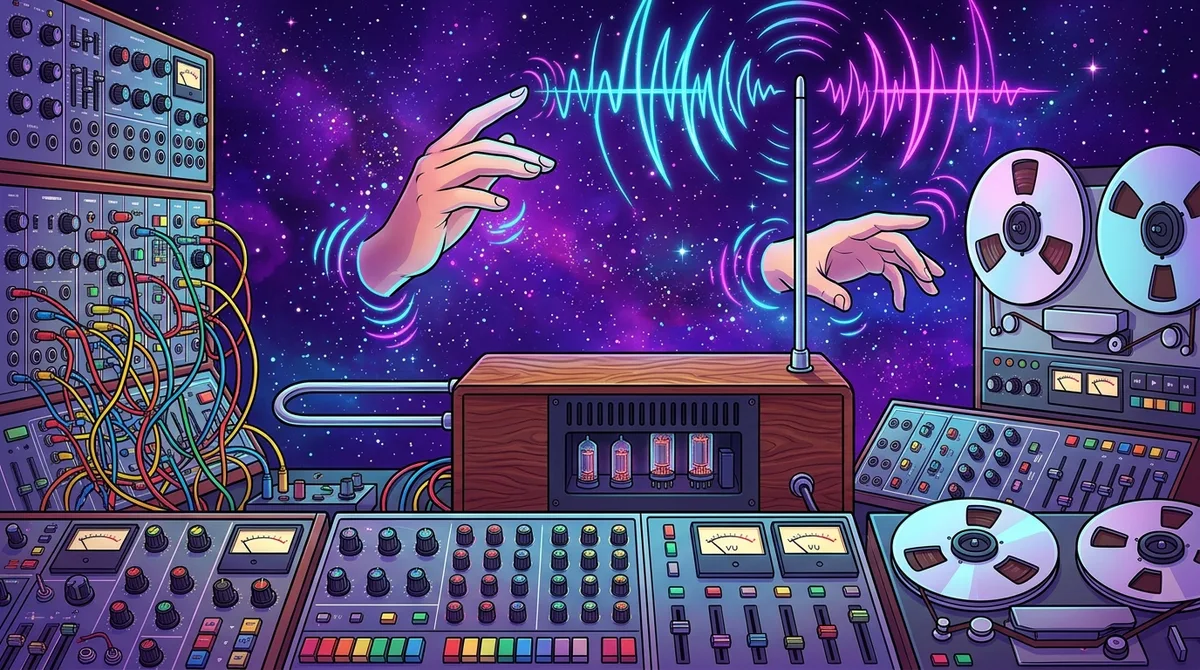
Early electronic gear proved that a machine could make sounds that seemed to come from another planet. Long before the European space-music movement took off, inventors were already messing around with electricity to create tones nobody had heard before, and those experiments paved the way for everything that followed.
The theremin is the spooky star of that early era. You play it without ever touching it. One hand moves near a vertical antenna to change the pitch, while the other moves near a loop to change the volume. The result is a wobbly, ghostly wail that sounds like a haunted spaceship calling home. If you have ever heard that eerie sci-fi whistle in an old movie, you have already met the theremin.
Harald Bode is another name worth knowing. He is linked to the early development of the synthesizer, the big idea that a machine could build sounds from scratch instead of just playing back recordings. His work helped lay the foundation for the machines that came after, so every glowing knob in a modern studio owes him a small thank-you.
The Moog synthesizer took that idea and made it much easier to use. Its modular design let musicians connect separate units with patch cables, so a sound could be shaped one step at a time. Once you had a sound you liked, you could save it, rebuild it, or send it to another part of the machine. That meant a spacey bleep didn’t have to be reinvented every time you wanted it.
That kind of control mattered for cosmic music. Drifting textures, echoing pulses, and slow swells are tricky to get right when every knob is fixed in place. With a modular setup, a producer could sculpt a sound until it felt like a lonely planet, then reuse it for the next voyage. Think of it as the first generation of starship cockpit controls, minus the flight manual.
Space music sounds like outer space because it builds a starfield from a handful of simple sonic tricks. Each one does a specific job, and you can hear them in almost every cosmic recording. Think of them as the cockpit controls for a ride through the void.
The toolkit is short, and it keeps showing up:
Klaus Schulze was one of the first to show how far these ideas could go. Fans point to his records Irrlicht and Cyborg as the blueprint, so if you want to hear the genre’s DNA, start there.
Not all the influence came from cosmic dreamers, though. Kraftwerk showed that machine-like, repeating rhythms could work in pop music, and that robotic beat later became a big part of spacesynth’s dance floor energy. Their work proved that a mechanical groove could feel catchy instead of cold.
Wendy Carlos took a different route. Her album Switched-On Bach showed a wider audience that synthesizers could play classical music. That mattered because listeners started hearing synths as serious instruments rather than gadgets for sci-fi sound effects. For spacesynth fans, that’s the moment the synth stopped being a toy and became a real musical tool.
Next time a track feels like it’s floating, listen for which trick is doing the heavy lifting. Is it the pulse, the arpeggio, or the reverb tail?

Jean-Michel Jarre’s Oxygène made space music mainstream by pairing long, drifting synth journeys with melodies that a huge audience could follow from start to finish. Jarre did much of the work himself, recording the album in his Paris apartment between August and November 1976 on an eight-track machine.
His setup was a tiny spaceship cockpit: the EMS VCS3, the ARP 2600, and an Eminent 310U organ. Each instrument added its own color, from the wobbly drones to the bright, bouncing lines that made the album feel alive.
Oxygène came out in France in December 1976. It has six connected instrumental parts and runs 39 minutes and 45 seconds, so it plays like one continuous voyage. There’s no vocal to lean on, which is exactly why the melodies had to do all the talking.
The album then took its trip overseas. It first charted on the UK Official Albums Chart on August 20, 1977, and climbed to number 2. It spent 11 weeks in the Top 10, which is a serious run for an instrumental record that few people had heard of a year earlier.
Those chart numbers only tell part of the story. Jarre’s official site estimates that the album sold about 12 million copies, a figure that shows how far a synth-led record could travel when people wanted to hear something new.
The story is still unfolding. Louder reported that a 50th-anniversary edition of Oxygène is scheduled for November 20, 2026. It includes a 2026 stereo remaster, Dolby Atmos and 5.1 mixes, and bonus content. Jarre’s Oxygene & Beyond tour dates are also listed for 2027, so the journey is far from over.
Italo disco and spacesynth met on the dance floor in the 1980s, when Italian and Dutch acts began attaching outer-space imagery to club beats. Cyber People and Koto are both named as early SynthDance acts. Cyber People began in 1984 on Mercury Records, and Koto’s single Visitors arrived in 1985. Both kept the sci-fi mood but made sure the track could be danced to.
The Dutch side of the story runs through Laserdance. The project released its first track under that name in 1984. Founder Erik van Vliet says its debut album, Future Generation, followed in 1987. That album marked the point where the spaceship landed and the crew started partying.
Those early records packed three ingredients into almost every track. There was futuristic imagery in the artwork and song titles, sticky synth riffs you could hum on the way to the car, and a steady dance beat underneath it all. The riff acted as the hook, the beat worked as the engine, and the imagery gave the whole thing its shiny paint job. Since most tracks had no vocals, the melody had to grab you on its own.
Laserdance kept flying. Erik van Vliet and Michiel van der Kuy made nine albums together through 1995. After a long break, they reunited for Force of Order, a gap of 21 years. Apple Music lists that record as a 2016 album.
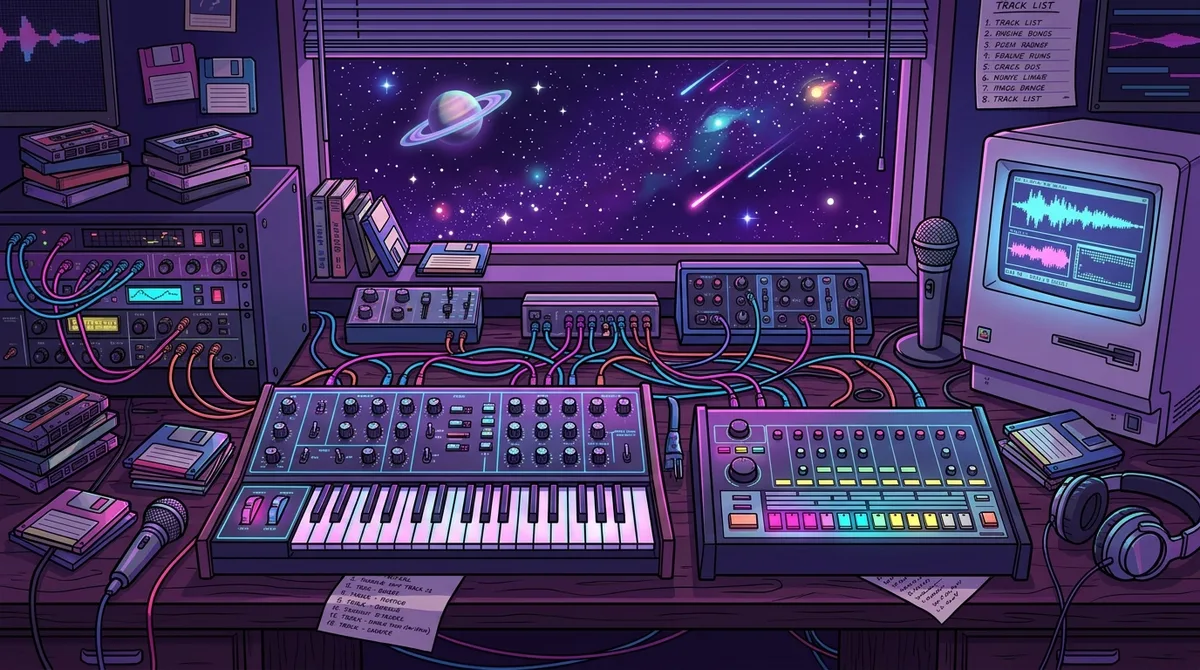
The 1980s spacesynth sound came from 1970s analogue synths passing the palette to a new generation of cheaper, more precise machines. The EMS VCS3 and ARP 2600 had already set the tone with wobbly drones, bright lines, and sweeping textures. Producers in the next decade adapted that palette with gear that could play sharper riffs and keep a beat locked in place.
Erik van Vliet named the main instruments used on Laserdance’s debut album, Future Generation, in a Studio interview. The list reads like a shopping cart from the era:
Each machine had a different job. The sequencer kept the arpeggios ticking like a spaceship’s autopilot, while the drum machine gave the track its engine. The vocoder added the mechanical, voice-like texture that fans now associate with the genre.
Hardware and software take different routes to the same sound. Hardware feels hands-on, with knobs you turn, sliders you nudge, and quirks that can surprise you on a good take. Software synths and sample packs make the sound easier and cheaper to reach, since you can get a Juno-style tone on a laptop without tracking down a vintage box.
Many modern spacesynth producers mix both. A hardware synth might carry the lead riff, while a software plugin handles the drums or shimmering pads. Blending the two gives you the grit of the original machines with the convenience of today’s tools, which is exactly the kind of cosmic crossover the genre has always loved.
Yes, spacesynth is still shooting for the stars, thanks to cult outsiders, affordable software, and a family tree that runs straight into mainstream pop. The scene never left the launch pad. It just found new ways to fly.
Take The Space Lady, a cult outsider performer whose cosmic, retro-futurist style fits right into the wider space-music world. Her sound feels like a transmission from a station nobody else can find, and that weird, handmade energy keeps the niche alive. Outsider acts like her remind you that this genre has always been happy to sound a little strange.
Today’s producers also have an easier launchpad than their 1980s heroes did. Software synths and sample packs let a bedroom musician summon a glossy lead, a pulsing bass, or a vintage drum hit without hauling a vintage box up three flights of stairs. A laptop, a pair of headphones, and a few good presets can turn a starry idea into a finished track before the kettle boils.
The synth-pop thread ties it all together. Spacesynth shares its DNA with the synth-heavy hits that filled 1980s charts, so every time a pop chorus sparkles with a bright arpeggio, you’re hearing a cousin of the starship sound. Those shared roots explain why a fan who loves a catchy 1980s single can end up deep in a spacesynth rabbit hole.
The Laserdance reunion proves the sound still draws a crowd. When the project’s founders came back together to make new music, longtime fans had a reason to tune back in, and newcomers got a front-row seat to a dance-floor classic reborn. Decades on, the crew is still ready to party.

Ready to turn a starfield into something you can wear? Retrowave lists standard unisex graphic tees at $27.00, and they’re often on sale for $22.95. Here’s how the main options compare:
The standard unisex tees are 100% Airlume combed and ringspun cotton, though the fiber content may vary by color. The fabric is light at 4.2 oz/yd² (142 g/m²), so it feels breezy under a hoodie or on a warm night at the arcade. The fit is retail, and the tear-away label makes it easy to remove the tag before you wear it.
If you want the whole galaxy on your body, look at the Blue Rays all-over-print tee. It’s 100% polyester with a regular fit, and it comes in 4.0 oz and 6.0 oz fabrics. The tagless design means nothing scratches your neck during a long synth marathon.
Both tee types run true to size, so your usual size is a good starting point. Before you order, check the size chart on each product page and compare it with a shirt you already love. Most items can be returned within 30 days of receipt if they’re in new condition. For questions about sizing or an order, you can reach customer support by email or through the Contact Us page.
Your next step is to pick one shirt and let the galaxy you love guide the choice. If you want the whole starfield on your body, the Blue Rays all-over-print tee covers you from collar to hem. If you prefer something simpler for a night out, a standard unisex graphic tee at Retrowave keeps the look clean.
Before you check out, open the size chart on the product page and note your usual size. Retrowave accepts Visa, MasterCard, American Express, PayPal, and other digital payment platforms. Once your order is placed, you’ll receive a confirmation email.
Shipping goes to most countries, but costs and delivery times change by destination, so check the details for your location before you pay. Custom orders can take longer to ship than standard ones, so plan ahead if you want a special print by a certain date. Need to change or cancel an order? Contact customer service quickly, because changes are only possible within a short window and may not be possible once the order is processed.
Join the Retrowave newsletter to hear about special offers and new arrivals. Have a sizing or order question? Reach out through our Contact Us page.