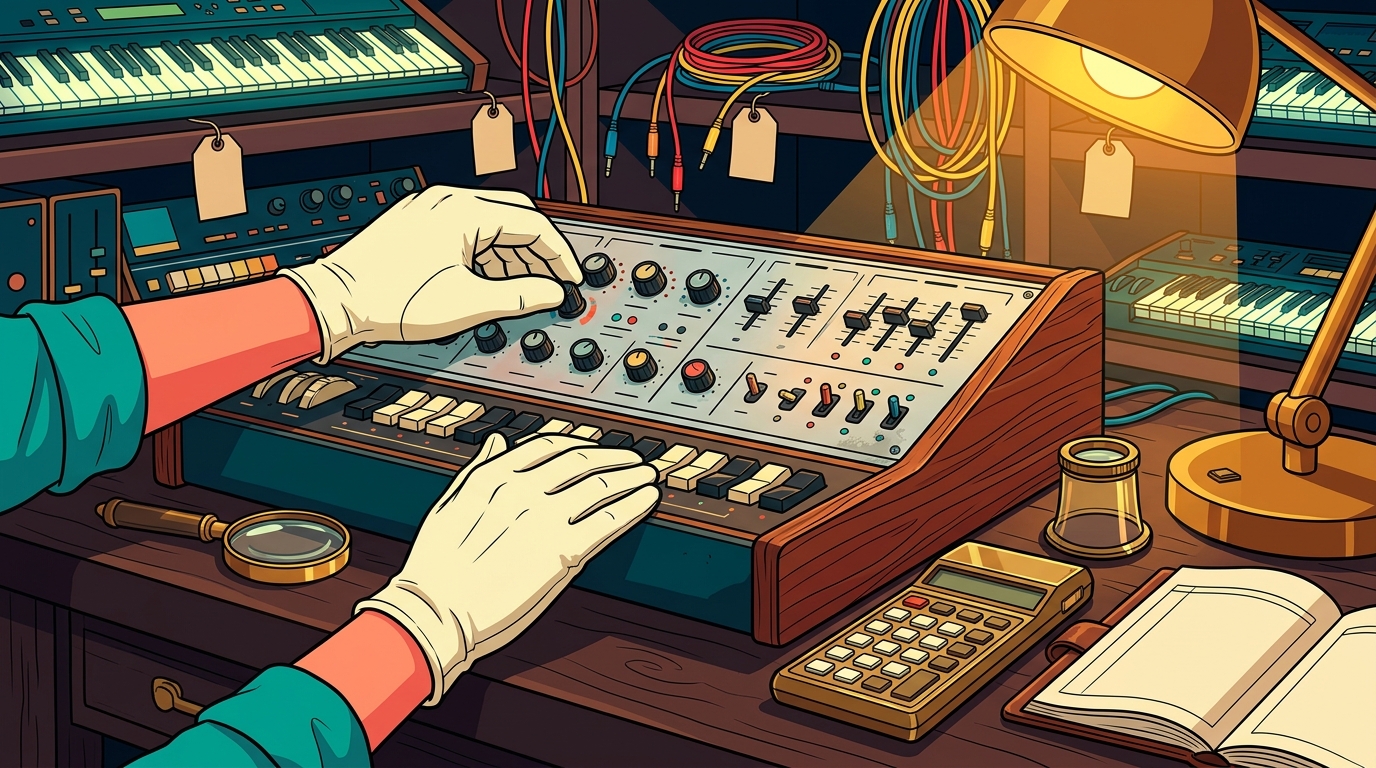
A vintage synth appraisal puts a real dollar figure on your analog beast, and that figure depends on why you need it. A likely sale price, an insurance value, and a tax-donation fair market value are three different numbers, so an appraisal that works for one job may be useless for another. Think of it like a Game Boy cartridge: the wrong one just won’t play.
Written appraisals for musical instruments often cost around $90 in the general market, and rare gear can push the value far past what you’d expect. Planning to donate? Under federal rules, a noncash gift worth more than $5,000 generally needs a qualified appraisal, plus Form 8283, Section B, with a valuation date no more than 60 days before the gift. Grab your flight case and let’s find out what your old synth is really worth.
Ask a synth what it’s worth and it will probably just blink at you. The answer depends on what you plan to do next. A likely sale price, an insurance value, and a tax-donation fair market value are three different numbers, and mixing them up is like sliding a floppy disk into a CD player. It just won’t work.
Before you call anyone, ask yourself one question: are you selling, insuring, donating, or restoring? Each answer calls for a different kind of appraisal. A seller wants to know what a buyer will actually pay. An insurer cares about what it would cost to replace the instrument if the worst happened. A restorer may need a report that records condition and originality before anyone unscrews a panel.
The gap between numbers can be wild. A circa-1976 Moog Minimoog Model D with its flight case, footswitch, and manuals carried a June 2021 auction estimate of $1,200 to $1,800, yet its displayed sale figures reached $3,750 and $4,688. A stage-played EMS Synthi A sold for $115,200 against a $15,000 to $20,000 estimate, which shows how much history and provenance can add.
Tax time is where a wrong number really hurts. Fair market value means the price a willing buyer and a willing seller agree on, with both sides reasonably informed. It is not the same as what your synth cost you in the 1980s. So pick your purpose first, and let the price follow.

A written appraisal for a musical instrument commonly costs about $50 to $90 in the general market, but a vintage synth can cost more because it takes more research. There is no verified standard price for synth-specific expertise, so treat that range as a starting point, not a promise. Think of it like arcade tokens: the price depends on which machine you’re feeding.
For vintage or unique instruments, an appraiser usually values the synth by its condition and by similar items sold in the current market. A common keyboard takes far less digging than a rare analog monster with its original flight case, footswitch, and manuals. Clean panels, working filters, and paperwork that proves the synth is original all give the appraiser more to check, and more checking often means a higher fee.
Be wary of anyone who wants a cut of the value. Under federal rules, a fee for a qualified appraisal generally cannot be based on a percentage of the appraised value. If someone quotes you a fee that rises with the price of your synth, politely close the browser tab and keep your 808 drum machine safe.
Before you hire anyone, ask for a written quote. Find out what the fee covers, whether it’s a flat price, how long the report takes, and whether it matches your reason for the appraisal. Appraisers typically want photos, the serial number, and notes on condition and originality, so gather those first. It will save you time, and it might save you a few dollars too.
Fair market value is the number the tax folks care about, and the IRS gives it a specific meaning. It is the open-market price that a willing buyer and a willing seller agree on. Neither one is forced to make the deal, and both know the relevant facts, like whether the filter still sweeps cleanly and whether the case latches.
Think of it as a fair trade at a swap meet, not a fire sale and not a lottery win. A seller who needs rent money can’t drag the price down, and a buyer who is panicking over a missing patch cable can’t demand a steep discount. Both sides have to be reasonably informed, so the number reflects what your synth is worth to someone who knows what they’re looking at.
Replacement cost is a different animal. It answers a simpler question: what would it take to buy a comparable synth today? That figure usually comes from a new-retail price or a shop’s replacement quote. IRS guidance treats it as separate from fair market value, so you can’t just swap one number in for the other on a tax form.
That’s why a shiny new-retail number is usually the wrong one. Picture a neon “NEW IN BOX” sign flickering over your beloved old keyboard. A brand-new unit carries a price that nobody pays for a used instrument, and a shop’s replacement quote tells you what a new box costs, not what your synth would fetch from a real buyer on the open market.

Price guides and auction results do most of the heavy lifting when it comes to a synth’s number. Reverb’s Price Guide records completed sales of used and vintage gear, and its estimates are based on recent sales of gear in the same condition. With more than 240,000 products in its database, it’s like a giant high score board for used gear, except it only counts the scores that actually got paid.
Condition is the biggest lever on that board. Two analog synths that look alike in a photo can land in very different price brackets, depending on whether the panel is clean, the keys are smooth, and the filters still sweep. Compare your synth only against sold examples in the same shape, not against flashy listings that never closed.
Auction records add a wilder layer. A circa-1976 Minimoog Model D, serial number 9625, came with its flight case, footswitch, and manuals. Its June 2021 auction estimate was $1,200 to $1,800, but the displayed sale figures reached $3,750 and $4,688. Those extras and that originality pulled the price well past the estimate, so check whether your own synth arrives with the same accessories.
Then there’s provenance, the rock star factor. A stage-played EMS Synthi A from the Florian Schneider Collection sold at Julien’s Auctions on November 19, 2025, for $115,200 against a $15,000 to $20,000 estimate. Don’t expect your garage Synthi to fetch that kind of money. A famous owner and a stage history made that one exceptional, so treat it as a headline, not a yardstick.
Before you compare numbers, check three things:
Pricing matters too. Reverb says listings priced within its recommended range typically sell within seven days, while higher asking prices may take longer. A dreamy asking price can look great on screen, but it may sit there gathering dust while the buyers scroll past.
Yes, if the synth you’re donating is worth more than $5,000, federal rules generally require a qualified appraisal and Form 8283, Section B, though some exceptions exist. Think of that $5,000 line as the final boss of tax paperwork. Skip the required items and the IRS won’t let you advance to the next level.
A qualified appraisal is more than a number scribbled on a napkin. It has to be done by a qualified appraiser and include the details the IRS expects, so ask any appraiser up front whether they handle donation reports. Your report also has to carry the right date.
That date has a time limit. The valuation effective date can be no earlier than 60 days before your contribution, so an appraisal from three months ago won’t count. Plan your timing the way you’d plan a limited-time arcade bonus round: start early, but not too early.
Timing gets even trickier if the appraiser finishes the report after you’ve already handed over the synth. If the report is dated on or after the day of the gift, the valuation date must be the contribution date itself. No cheat codes here, so line up the appraisal and the handoff on the same day, or get the report done before you ship or drop off the keyboard.
Form 8283 is where the appraisal details go when you file your return. Section B is the part for larger noncash gifts, which is why a synth over the threshold lands there. Keep copies of everything, including the appraisal, photos, and any receipt from the organization that received your gear, because the paper trail is what proves your deduction.

No, your appraiser doesn’t have to follow USPAP just because they know their stuff. USPAP, the Uniform Standards of Professional Appraisal Practice, is a named professional standard that applies across appraisal fields. The Appraisal Foundation, which oversees the standard, says that USPAP is not legally required for personal-property appraisers solely because of the work they do.
So what decides it? Compliance depends on the rules that apply to your situation. That can mean state law, a government agency’s regulations, or a client’s own policy. If a client, agency, or state law requires a USPAP-compliant report, that requirement is what makes the standard binding on the appraiser.
The standard also keeps evolving. On April 23, 2026, the Appraisal Standards Board adopted Advisory Opinion 41, which addresses appraisers’ responsibilities when using technology, including generative AI, for real-property, personal-property, and intangible-property assignments.
Before you hire anyone, ask them two questions. Will my report follow USPAP, and do I need it for my purpose? Then ask how they use software and AI in their research. You wouldn’t start a run without checking the cheat codes, so don’t skip the paperwork.
Before the appraiser arrives, give your synth a little photo-shoot glamour. Take clear shots of the front panel, the back jacks, and any cracks or scratches you can see. Then work through this pre-game checklist:
Be honest about that modified filter board or the old repair someone did. An appraiser would rather hear the truth up front than discover a surprise halfway through the report. Keep your receipts too, since they help prove ownership and originality.
Values shift as the market changes, so think of your appraisal as a snapshot, not a permanent high score. As a general rule, appraisals are worth refreshing about every five years, so mark that date on your calendar and get ready to beat your own old number.
Your next move depends on the purpose you picked at the start. If you’re selling, open the Reverb Price Guide, find completed sales of your exact model, and compare only against units in the same condition as yours. Skip the flashy asking prices that never sold, since a listing is just a hopeful guess until someone pays.
If you’re donating and your synth could be worth more than $5,000, email a prospective appraiser this week. Ask two questions: do they write qualified appraisals for donations, and can they date the report within 60 days before your gift? Then schedule the appraisal and the drop-off so the dates line up, like hitting the bonus round on the right day.
If you’re insuring or restoring, ask the appraiser exactly which value the report will state and why. A number that answers the wrong question can be as useless as a cartridge that won’t load.
Whatever your purpose, send a short message with your serial number, your photos, and a request for a written quote. Don’t pay until that quote shows what the fee covers and how long the report will take. Then press start and let the paperwork begin.