There’s no single published U.S. price for a retrowave wedding band. As a starting point, live wedding-band averages range from about $2,050 on WeddingWire to $4,500 in The Knot’s study of couples married in 2025. That gap is a budgeting clue, not a price tag for your specific act.
For a closer 80s-flavored comparison, GigSalad lists 1980s-era entertainment at $500 to $3,650 for a commonly booked three-hour event. Those figures use different samples and booking details, so they won’t match every neon-soaked reception. Band size, set length, equipment, travel, and custom song requests can all change the quote. This is about live music, not retrowave-style wedding rings: think synths, big hooks, and a dance floor ready for its montage scene.
There’s no single published U.S. price for a retrowave wedding band, so treat broad industry figures as budget clues, not a quote for your neon-drenched dance floor.
The Knot reports that couples married in 2025 spent an average of $4,500 on a live wedding band, based on responses from 10,474 U.S. couples. WeddingWire puts the U.S. wedding-band average at about $2,050, with a typical reported range of $489–$5,720. That spread is a reminder that wedding-band costs can vary widely. Your budget matrix isn’t glitching.
For an 80s-flavored comparison, GigSalad lists 1980s-era entertainment at $500 on the low end, $1,500 on average, and $3,650 on the high end for a three-hour booking. Its pricing page was updated December 2, 2025. These figures cover a broad category of 1980s-era entertainment, not a guaranteed price for a retrowave wedding band.
Those benchmarks measure different things. The sources use different samples, locations, booking lengths, and pricing measures. A starting price may not be the final price, either. The number on a listing can be the opening level, while your event quote depends on its specific details. Think of these figures as the opening screen, not the final boss.
And to keep the genre straight, this is about hiring live music for your wedding, not buying retrowave-style wedding rings. Expect guitars, synths, and familiar 80s hooks, not a jewelry guide with a side of neon.

Wedding-band price benchmarks can look far apart because an average, a quartile, and a reported range describe different parts of the spending picture. The Knot’s lower-cost, median-cost, and upper-cost quartiles are $900, $1,900, and $7,000. Quartiles show how spending falls across groups: the median marks the midpoint, while the lower and upper quartiles mark lower and higher points in the spread. They aren’t three prices for the same kind of band.
An average combines spending into one figure, so higher-cost bookings can pull it upward. The Knot reports an average of $7,300 in the Mid-Atlantic and $3,200 in the West. That regional gap is enough to make your budget spreadsheet do a double take. A national average can blur differences between markets.
WeddingWire reports a typical price range of $489–$5,720 and an average of about $2,050. The range shows how far reported prices stretch, while the average gives you a single snapshot of the middle of the math. Neither tells you what a specific retrowave act will charge.
The Knot’s average for couples married in 2025 is $4,500, compared with WeddingWire’s average of about $2,050. Those figures don’t automatically contradict each other: the sources can use different samples and measures. Even within one area, your quote depends on the booking. A larger lineup, longer performance, extra equipment, travel, or custom song requests can change the total. A broad national number helps set the scene, but it’s no crystal ball for your neon-lit reception.
80s-focused acts have advertised prices ranging from $750 and up to starting prices of $3,500, but those figures aren’t universal rates or direct comparisons.
The Knot describes Nashville’s Bueller & Party of 5 as specializing in 1980s hits and lists a $2,800 starting price. The Knot also lists Southern California 80s cover band Radio Royalty at a $3,500 starting price. Both are advertised starting prices, not guaranteed totals for every wedding or booking setup.
GigSalad lists Orlando-based Decadence 80s Band at $750 and up, with a stated gig length of 45–240 minutes. That “and up” format differs from The Knot’s starting-price listings, and the listed gig length covers a wide range. These figures alone don’t show that Decadence is a like-for-like cheaper option.
The acts differ in location, booking details, pricing format, and the acts themselves. A listed starting price may not include every service or booking detail you need. Ask each band what its listing covers, including performance length, musicians, equipment, travel, and custom song requests. Then compare quotes for your event. The neon may be the same shade, but the package details can tell a different story.
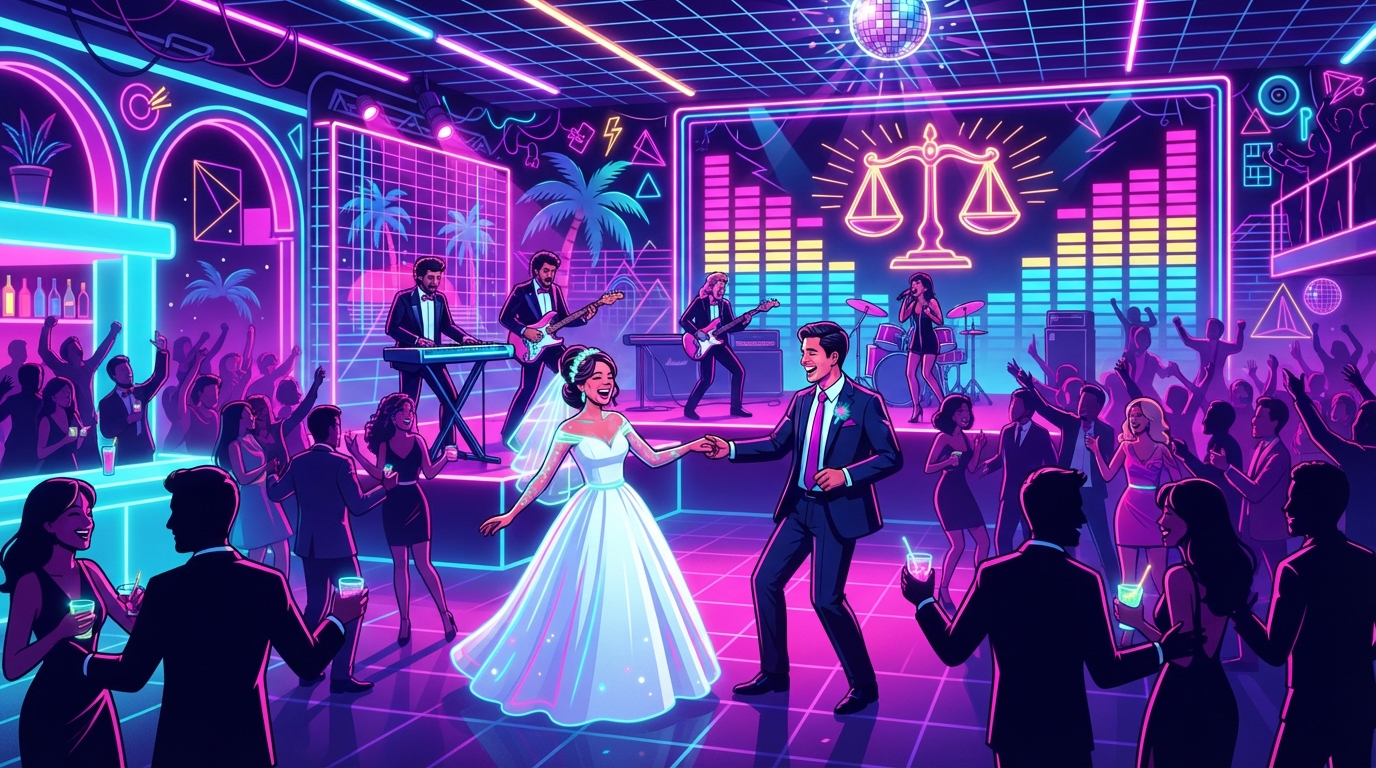
Your final quote can change with the lineup, performance time, equipment, event location and date, travel, experience, and custom requests. The neon is optional; the booking details aren’t.
Band size is one factor: a quote for several musicians may differ from one for a smaller lineup. Set length matters, too. Clarify how long the band will perform in total, since a short set and a longer event are different bookings. WeddingWire and The Knot both identify musician count and performance duration as pricing factors.
Check the lineup: Confirm how many musicians are included. Specify the performance: Set the performance length and total time you want live music. Ask about equipment: Check whether technical equipment and anything else you need are included. Share the location and travel: Give the venue location and date, and ask how travel and any travel fees affect the quote. Mention custom requests: Include special song choices, especially songs the band would need to learn.
Equipment needs can change the total, so make sure you and the band mean the same thing by “included.” A synth-heavy retro set might sound ready for an arcade boss battle, but the quote still depends on the technical setup the act requires.
Location and date can affect pricing, and travel may matter if the band is based far from your venue. GigSalad says 1980s-era entertainment prices also vary with event length, location, travel, experience, and other booking details. The Knot likewise identifies travel fees and custom requests as factors for live wedding bands. A request to learn a new song may affect the quote, so mention any must-play tracks while discussing the booking.
You can compare retrowave band quotes fairly by asking every act for the same event-specific details, then weighing complete totals instead of headline prices. Use WeddingWire and The Knot’s published pricing factors as your question checklist. Their lists point to lineup size, performance time, equipment, location and travel, and custom song requests. Asking everyone the same questions keeps your comparison from turning into a high-score screen with missing data.
A simple comparison sheet can help: give each act one column and use the same questions in every column. If a quote leaves an item unclear, mark it as unconfirmed instead of assuming it’s included. That way, you’re comparing actual offers for your reception, not three different versions of “live 80s music” glowing in your budget spreadsheet.

Before setting a number, decide what matters most for your reception: a full live-band experience, a particular lineup size, a longer performance, or specific custom songs. You might have one must-have and a few nice-to-haves, but naming your priority helps you decide which booking details are worth stretching for and which can stay in the bonus round.
Use the published figures in this article as planning context, not as a guaranteed quote for your wedding. Broad averages, 80s-entertainment prices, and advertised starting prices describe different kinds of bookings. Your event’s lineup, performance length, equipment, travel, and song requests can change the final cost.
As you research wedding entertainment options, compare quotes based on the same details: wedding date, venue location, number of musicians, total performance time, equipment, travel, and custom songs. Ask each act to clarify what its quote includes, then line up the answers side by side. Matching the booking details makes it easier to see what fits your priorities and budget, with fewer surprise boss battles when the final quote loads.
Open your wedding budget and set a firm maximum for live music. Treat it as the amount you can spend, not the amount you hope a band’s advertised starting price will cover. If your entertainment budget has to cover more than the band, account for those other costs before choosing your ceiling.
Then send your shortlisted acts the same direct question: “Our maximum for live music is $X. Can you suggest an option that fits? If not, what’s the closest option, and what would need to change?” Include your wedding date and venue so the answer is about your event, not a generic price estimate.
If a full lineup or long performance pushes a quote past your limit, ask whether a smaller lineup or shorter set is available. Get the revised offer in writing, and check whether custom song requests change the total. Don’t assume a scaled-back option exists just because it sounds like an easy settings-menu fix.
If no suitable option fits your ceiling, decide together whether to adjust a nice-to-have or keep looking. That decision is easier before you get emotionally attached to a band’s live version of your favorite 80s anthem.