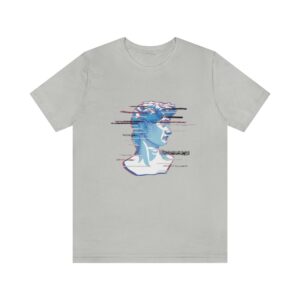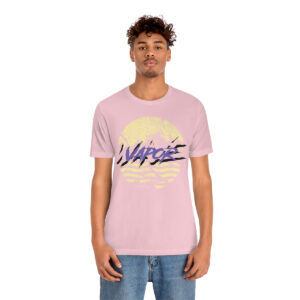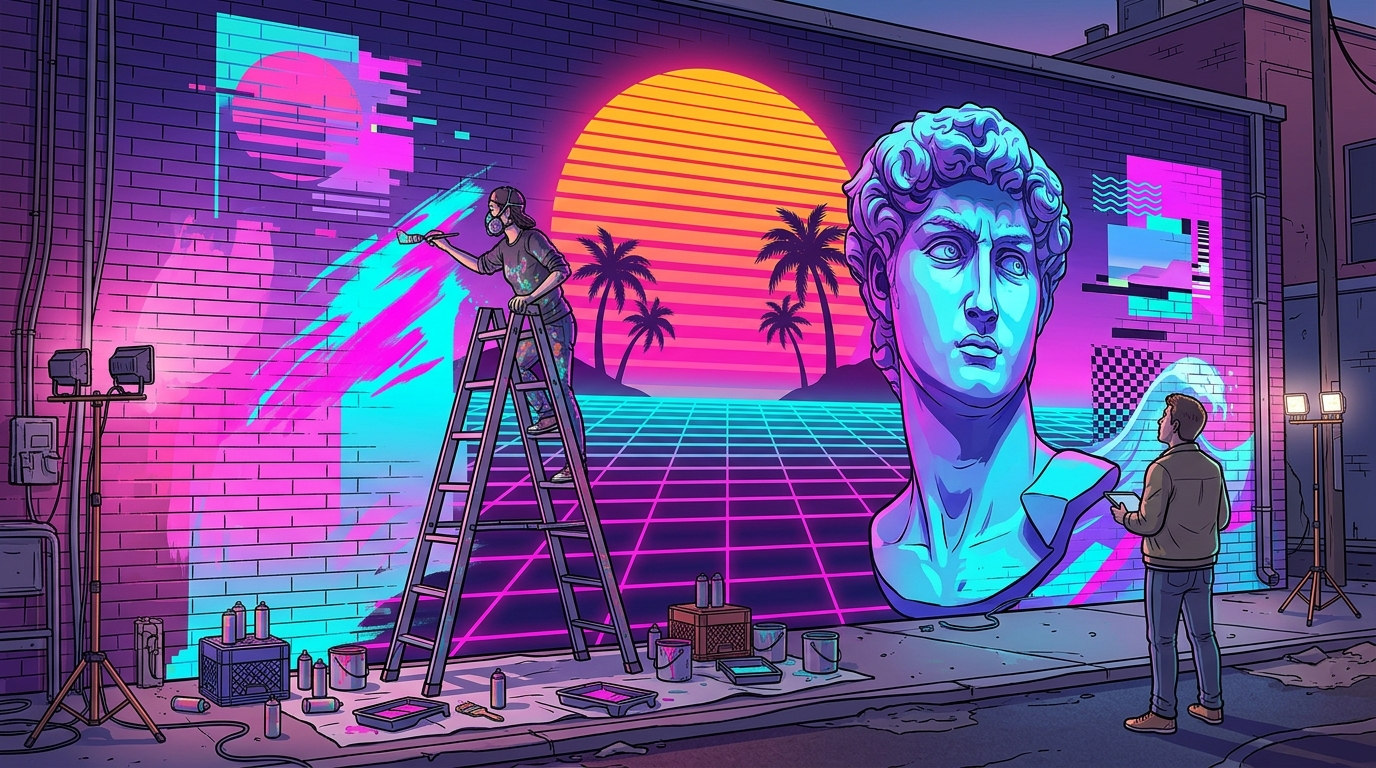
A vaporwave mural commission brings an online-born aesthetic into your space, as a hand-painted feature or a printed design made to fit your wall. Your brief might pair a Greco-Roman statue with pink-and-cyan gradients, checkerboards, VHS effects, or a nod to 1990s web design. That’s much more useful than asking for a vague blast of neon. These motifs draw on a style that emerged in online communities in the early 2010s, as Mutual Images Journal explains.
Before you contact artists, note your wall’s size, preferred production method, and what you want the artwork to do in the space. Published planning benchmarks put mural costs at $10–$65 or more per square foot. Installation and scheduling depend on the project and site. A focused brief helps you compare portfolios and request useful quotes, so your dream arcade wall doesn’t turn into a game of “guess the scope.”
A vaporwave mural commission brings vaporwave’s online-born visual style into your space as a hand-painted mural or printed installation. Vaporwave began as a digital-born music genre and visual-aesthetic trend in online communities in the early 2010s, according to Mutual Images Journal. Your commission connects digital references to a real wall through choices about composition, scale, surface, and materials. A design that looks crisp on a screen may need adjustments to fit your wall, work around doors or fixtures, and stay readable from across the room. Paint applied directly to the wall and a printed image installed on it can also create different finishes, so make the production method part of your plan. Your mood board might include Greco-Roman sculpture, pink-and-cyan gradients, checkerboards, VHS or CRT effects, low-poly 3D, Japanese text, and nods to 1990s web design. These are options, not a mandatory checklist. VAPORWAVEART’s visual-language overview lays out familiar cues, but your mural doesn’t need every relic from the internet’s neon attic. The strongest concept fits your room, wall, and purpose instead of copying a mood board wholesale. In a game room, a bold focal image might fit the vibe. In a shared workspace, a more open composition could keep the wall from shouting over everything else. Tell the artist what the space is for, what should catch your eye, and how you want the wall to feel. That gives your references a job beyond “make it neon.”

Your artist brief should describe your wall, visual direction, production method, room, and project checkpoints. A useful brief gives each artist the same details, making quotes and concepts easier to compare. Start with the wall itself. Include its location, approximate height and width, surface condition, and how the artist can access it. Note doors, windows, outlets, lights, pipes, or other features that could interrupt the composition. A surprise radiator is no time for a surprise composition. Share reference images, then say what you like and what you want to avoid. For example, you might want a marble statue, neon gradients, checkerboard patterns, VHS glitches, or retro web graphics, but no skulls, crowded text, or faux graffiti. Give the artist room to make the design original instead of tracing your mood board like a treasure map. Tell prospective artists:
Be clear about practical limits, too. Name colors, imagery, or messages the design must include, and flag anything that would make the wall hard to use. A clear scope gives artists a fair shot at proposing an original design instead of guessing what “more outrun, less haunted mall” means.
Choose a mural artist whose visual style fits your idea, whose portfolio shows large-scale work, and whose production process makes the project feel manageable. A portfolio full of polished digital vaporwave illustrations can show style, but it won’t tell you how the artist handles a real wall. Look for murals or other large-scale work, and see how the compositions fit around edges, doors, fixtures, and the surrounding space. Check whether the artist adapts designs to different surfaces or makes every wall look like the same flat screen.
Compare both mood and craft. A vivid vaporwave arcade scene may suit your game room, while a subtler statue-and-gradient treatment could work better if you want the wall to set a mood without hogging the whole show. Look for portfolio examples of hand-painted vaporwave murals, and ask artists whose work fits your vision whether they take commissions.
When you contact artists, send your project brief, wall location and dimensions, surface details, reference images, preferred production method, and desired schedule. Describe how you want the artwork to feel and point out any doors, lights, or other features the design needs to work around. Ask what the proposal and quote include, such as concept development, design revisions, materials, wall preparation, and installation.
Get a feel for the working process before choosing. Ask how the artist presents concepts, how you can give feedback, who supplies materials, and whether wall preparation or site access could affect the work or schedule. Compare communication and physical-mural experience alongside the portfolio. The artist with the most aggressively pink portfolio isn’t automatically the right fit for every wall. Sometimes your space wants a neon arcade, and sometimes it wants a statue having a quieter internet-era moment.
A vaporwave mural commission can cost very different amounts depending on your wall and the work involved, so a per-square-foot figure is only a rough planning benchmark, not a quote. Published mural benchmarks range from about $10 to $65 or more per square foot, with stated project minimums ranging from $3,000 to $5,000. Treat those broad market figures as a starting point, not a neon-colored price tag for your exact project. Your quote reflects the actual scope. Wall preparation, access, equipment, timing, travel, and materials can all affect the total. So can the level of design detail. A simple gradient and checkerboard may involve a different workload from a dense scene with a statue, layered VHS effects, and careful work around fixtures. A hand-painted mural and a printed installation also involve different materials and production steps, so say which method you want when requesting prices. Timing depends on the artist and site. One general planning benchmark is about one to two installation days per 100 square feet, plus at least six weeks from contract signing to application. Those figures are planning guidance, not a guaranteed schedule. Your wall’s condition, access, and project scope can change the timeline. Ask each artist for a written quote that spells out design work, revisions, materials, preparation, installation, travel, and any exclusions. Check whether the quote includes equipment or expects you to arrange it. Then compare proposals with the same scope. A lower number may leave out wall prep, design revisions, or other work another artist has included. That bargain can feel less like a power-up and more like a surprise boss fight.
Sometimes, yes. Mural approvals depend on who controls the wall, how the artwork is made, and local rules. First, identify the wall’s owner or manager, then confirm requirements with the relevant city or property manager before scheduling work. A hand-painted vaporwave scene and a digitally printed neon wall may not follow the same permit path, as Portland’s mural guidance illustrates, so don’t lock in an installation date based on vibes alone.
Portland example: Portland defines an “Original Art Mural” as visual art hand-produced by painting or tiling directly on an exterior building wall, or affixing art directly to one. Mechanically produced or computer-generated images, including digitally printed vinyl, are excluded from that permit category, according to Portland Permitting & Development. The city says the permit takes approximately 30–40 days from application to issuance, and on-site work cannot begin before the permit is issued. Put that wait in your schedule, not in the “we’ll figure it out later” folder.
Raleigh example: The city says artwork can be painted on privately owned walls without city permission, but a design that functions as a billboard or sign by referencing a business or using logos requires a sign permit. Raleigh’s mural guidance also describes a review process for proposed murals on city-owned walls. That review takes 1–3 months, excluding permitting and contracting, and calls for artist samples, a proposal, estimated project cost, funding sources, and a proposed timeline.
Portland and Raleigh are location-specific examples, not a neon-lit cheat code for every city. Rules can vary with the wall and production method, so check the requirements where your mural will go before setting an installation date.
Protect your vaporwave mural commission with a written agreement that spells out payment, schedule, concept approvals, revisions, and who handles installation responsibilities. Name who supplies materials, prepares the wall, arranges access, and completes the installation. Set out what happens if the concept, wall, scope, or schedule changes, including how you’ll approve revised costs or dates before work continues.
Copyright deserves its own clear clause, not a tiny line hiding in the contract’s end credits. Copyright for an original visual work begins when the work is fixed in a tangible form, such as a painted mural or a digital design. The creator is generally the initial copyright owner unless a work-made-for-hire exception applies, according to the U.S. Copyright Office’s guidance for visual artists.
The copyright owner controls copying, adaptation, and public display. Permission to display a mural on your wall doesn’t automatically give you broader permission to reproduce its design on merchandise, adapt it for another space, or use it in promotional materials. If your artist plans to use protected imagery created by someone else, confirm that permission covers the intended uses too, as explained in the U.S. Copyright Office’s copyright guidance.
Ask the agreement to state who owns the design and which rights you receive, including permission to photograph, reproduce, adapt, or use the artwork in promotion. Use original or properly cleared references. A mood board is a creative compass, not a magical copyright invisibility cloak.
Start your shortlist with artists whose portfolios show finished murals on walls like yours, not just vaporwave illustrations on a screen. For a hand-painted exterior wall, look for outdoor mural work. For a printed design, look for examples of large printed installations. Note what each example shows about fitting artwork around doors, lights, or other features on your wall.
Then sort candidates by production method and project fit. A painter whose work leans into sculptural figures and gradients may suit a statue-led design, while an artist with bold graphic compositions may be a better match for checkerboards and arcade imagery. Keep your shortlist focused on artists whose work feels right for your space, not simply the loudest neon in the portfolio.
Send the same project note to each candidate you’re considering. Include the wall location, dimensions, surface, preferred method, visual references, and target schedule. Ask for a proposal that identifies concept costs, revisions, wall preparation, materials, installation, and any exclusions. For an exterior project, ask what local approvals or site conditions could affect the schedule. For imagery based on existing artwork, ask how the artist handles permissions and what reuse rights the agreement would give you.
Compare the replies side by side. Remove any candidate whose portfolio or proposal leaves a major project requirement unanswered, then contact the artist whose work and process best fit your wall.