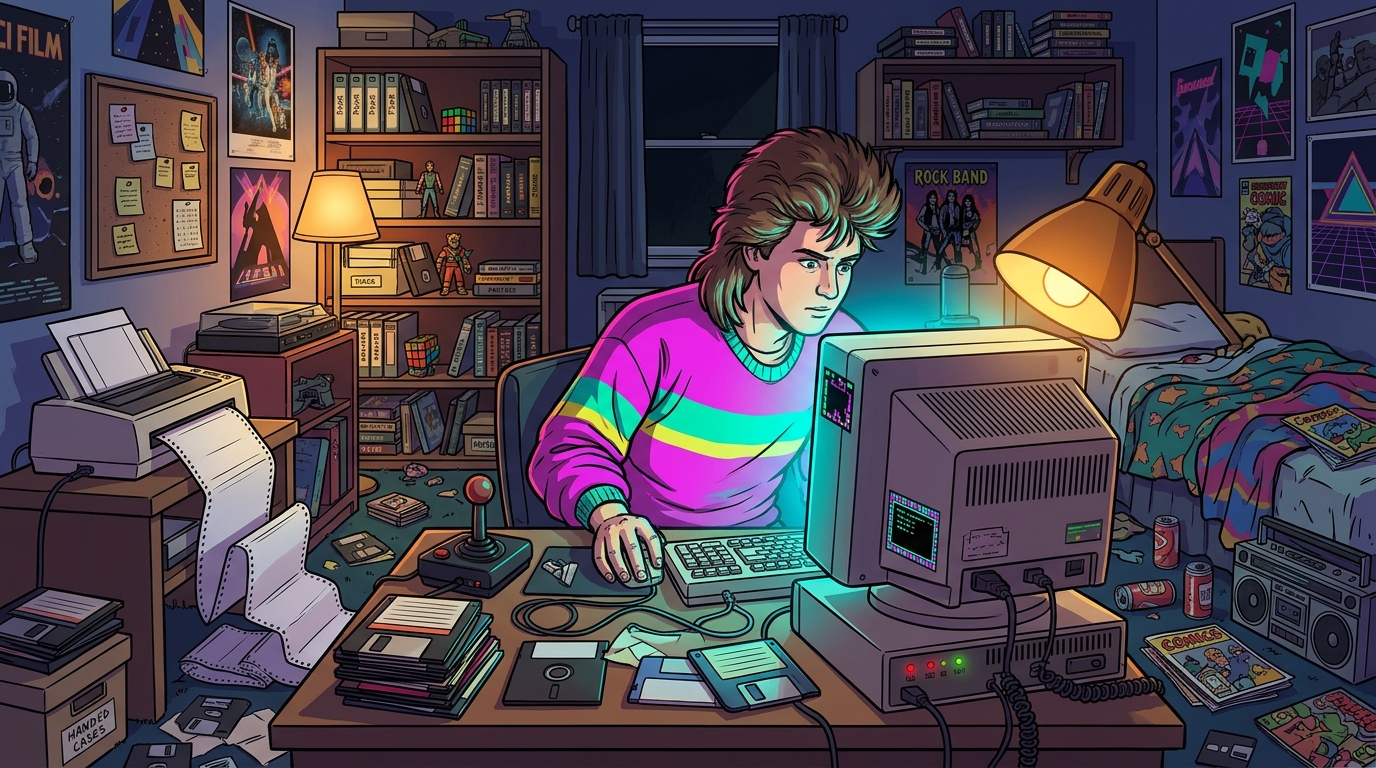
1980s BBS culture grew out of ordinary home computers that answered the phone, and one 1983 how-to book alone listed more than 275 public boards in 43 U.S. states. Before the web rolled in with its blinking cursor, the whole scene ran on a single phone line, a modem squealing like a fax machine having a bad dream, and a text screen glowing in somebody’s spare bedroom.
Most of those boards were free or charged only a nominal fee, which was lucky, because long-distance phone bills were the real villain. A call to another state could cost a small fortune depending on distance and time of day, so most callers stuck to numbers down the street. Then in 1981 Hayes shipped its Smartmodem, a 300-bit-per-second box that could take commands straight from a computer, and suddenly everyone had a reason to hit dial. Grab your neon-striped jacket and let’s see what these boards were really like.
A 1980s BBS was a small dial-up system, usually a home computer or a club’s machine hooked up to one phone line, where callers left messages, swapped files, and hung out with people who shared their interests. Picture a humming beige box in somebody’s spare bedroom, a green text screen glowing in the dark, and a phone line the whole family was strictly forbidden to touch.
The magic trick was simple. You dialed the number, your modem squealed its robot hello, and if the board picked up, you were in. There were no slick logins or app icons. You typed a handle like “NeonNinja88,” and the sysop (the person who ran the machine) decided how much of the board you could see.
Back in 1986, a U.S. Senate report described electronic bulletin boards as networks that computer users created themselves to pass information between computers. They could be commercial or noncommercial, public or semi-public. Translation: whoever had a modem and a free weekend could start one.
The granddaddy of them all was CBBS, which went online in Chicago on February 16, 1978. Ward Christensen and Randy Suess built it, and the name said exactly what it was: a Computerized Bulletin Board System. Subtle, it was not, but it worked.
The message boards were the real hangout spot. Think of a corkboard in a high school hallway, except the notes were typed, threaded, and argued over for weeks. Regulars learned each other’s handles, logged on at the same time every night, and built inside jokes faster than a synthwave track builds a drop.
Some boards even talked to each other. Systems in different towns traded messages overnight through networks like FidoNet, so a post written in one city could show up in another by morning. Your friends were no longer limited to the few neighbors who happened to dial the same number as you.

Most callers reached boards across town by dialing a local number, because the phone bill was the real boss. Long-distance charges depended on how long you stayed connected, how far away the other board sat, and what time of day you called. A late-night chat with a board in another state could leave your family wondering why the phone bill suddenly looked like a car payment.
Modems were the upgrade that made the scene bigger. Hayes shipped its Smartmodem in 1981 as a 300-bit-per-second box that could take commands straight from a computer, so your software could dial and hang up without you lifting a finger. Faster standards followed. ITU-T Recommendation V.32 specified duplex modems up to 9,600 bit/s, which meant files crawled across the line far less slowly.
Networks solved the distance problem in a sneakier way. Boards called their neighbors during cheap overnight hours, passed along whatever messages had piled up, and the mail hopped from system to system until it reached its destination. FidoNet was the best-known example, and its BBS Preservation Project history notes it grew from 50 listed boards in September 1984 to more than 160 by early 1985. Your message might take a while to reach a friend in another city, but nobody was complaining about the price.
Then there were the big commercial services. CompuServe was not a typical hobbyist board, but a commercial online service with its own rates. In May 1984, its CB chat channels dropped from $12 an hour to $6 at 6 p.m., a discount that made the neon-lit chat rooms a little easier on the wallet.
Most callers were hobbyists who already owned a computer and a modem, joined by students, gamers, programmers, and lonely night owls who found their people after midnight. You might log on expecting a tech wizard and instead find a teenager arguing about a text adventure, a nurse looking for a pen pal, and somebody who just wanted to talk to anyone at 2 a.m.
Nobody counted them all, so every number here is a guess. A 1987 guide estimated that 1,500 to 2,000 BBSs were operating, but the historical research paper that reports the estimate notes that such counts were rough, since no comprehensive list ever existed.
The best snapshot of the crowd comes from a U.S. Census survey. Of the 16.8 million adults who reported using a computer at home in 1989, about 5.7% also said they accessed a bulletin board. That sounds small, but picture thousands of glowing screens tucked into spare bedrooms across the country.
Then there were the sysops, the people who ran the boards. Most were regular folks with a spare machine, a stubborn streak, and a phone line they paid for themselves. They kept the software running, answered questions, and settled arguments, all for free. The payoff was mostly thank-you messages and bragging rights, which is why a board could vanish overnight when its sysop landed a new job or a new girlfriend.

Every good board had a file library, and that’s where the real treasure lived. Callers uploaded and downloaded programs, text files, and shareware, which was the old honor system where you tried a program for free and sent the author a payment if you kept using it. A single download could tie up your phone line for a long, long time, so you picked your files carefully and hoped your parents didn’t pick up the extension.
Then came the door games. A door was an add-on program that opened a separate game inside the board, and you walked through it like a neon-lit hallway into another world. Trade Wars was the crown jewel. You piloted a ship through a galaxy of numbered sectors, bought and sold cargo, and tried to outsmart or ambush other players on the same board. Other favorites included:
Visually, the boards were a show-off’s dream. ANSI art used special color codes and character blocks to paint logos, borders, and menus on a text screen, so a single board could look like a glowing arcade cabinet or a grimy garage band flyer. Sysops picked their colors and symbols carefully, and the screen told you right away whether the board was chill, chaotic, or proudly weird.
Text files and ASCII art became a shared visual language that traveled from board to board. Your favorite group’s logo might sit at the top of a dozen different systems, and release notes often came wrapped in decorative borders. TEXTFILES.COM now keeps much of that material around, so you can wander through the old text screens and see what the scene looked like when every pixel was a letter.
The law of the 1980s had not fully caught up with bulletin boards, so lawmakers were still figuring out how computer rules applied to them. Nobody handed sysops a neat rulebook, and the details depended on what a board did, not just that it existed.
The main federal computer crime law of the period was the Computer Fraud and Abuse Act of 1986, found at 18 U.S.C. § 1030. It focused on unauthorized access to computers and computer-related fraud, and it was fresh off the press just as boards were multiplying across spare bedrooms.
Lawmakers did not treat boards as shady gadgets. Electronic bulletin boards were viewed as communication networks that computer users created themselves, which could be commercial or noncommercial and public or semi-public. In other words, a board was seen as a legitimate way to pass information around.
Trouble tended to come from what people posted and traded. Boards that mixed hacking chatter or stolen data with everyday small talk drew the most attention, and that was the stuff that made phone companies and parents nervous. Many sysops responded by writing house rules, such as no swapping cracked passwords, no posting stolen credit card numbers, and no hacking talk in the main hall.
Those rules usually lived in a welcome screen or a text file that greeted you before the menu appeared. Break them, and the sysop might boot you, ban your handle, or quietly wipe your account, which made the sysop the most feared figure in the whole neon-lit dial-up world. This is a broad look at the era rather than legal advice, so check today’s rules wherever you live before you fire up a board of your own.
The BBS scene lives on in three places: searchable archives of old board numbers, software that still gets updates, and hobbyists who run boards for fun. It’s like a neon sign that never quite switched off.
Start with the paper trail. The searchable Historical BBS List is where people hunt for old board numbers, and its February 2026 correction separated 108,078 archival listings from an estimated 103,110 distinct boards across 268 North American area codes. So if you’re chasing a number from 1989, someone has probably already logged it.
The software is still kicking, too. Renegade BBS version 1.40 came out in March 2026, proof that a program from the dial-up era can still get a fresh coat of paint and a new feature or two.
Networks have a legacy as well. In the early 1990s, EchoMail carried an estimated 500 to 1,000 shared message conferences on FidoNet, so a single thread could bounce from city to city like a pinball.
Retro fans carry on the original spirit. They run boards and archives today as a hobby, trading files and posting in the same spirit as the sysops who kept their machines running for thank-you messages and bragging rights. All you really need is a spare computer, a phone line, and a soft spot for blinking text.
Ready to dial in yourself? Start with a treasure hunt instead of a dusty beige box. Search the archive of old board numbers for listings near your area code, then pick one that still looks alive. Expect a lot of dead lines, since a number from 1989 is more likely to reach a fax machine than a friendly sysop.
Next, set up your own spare-bedroom board on a phone line you can spare for an evening. Choose a modem that supports V.32 speeds up to 9,600 bit/s so your files don’t crawl across the line. Then add a Trade Wars-style door game, because nothing hooks callers like a rival who keeps stealing your cargo.
Before your first caller shows up, write a welcome screen with house rules. Ban stolen credit card numbers, cracked passwords, and hacking talk in the main hall, the same rules that kept many 1980s boards out of trouble. Check your local laws too, because this guide is only a broad look at the era.
Finally, invite one friend, log on at the same time every night, and start building your own inside jokes. Just remember to turn off call waiting, or your board will be the one that never picks up.